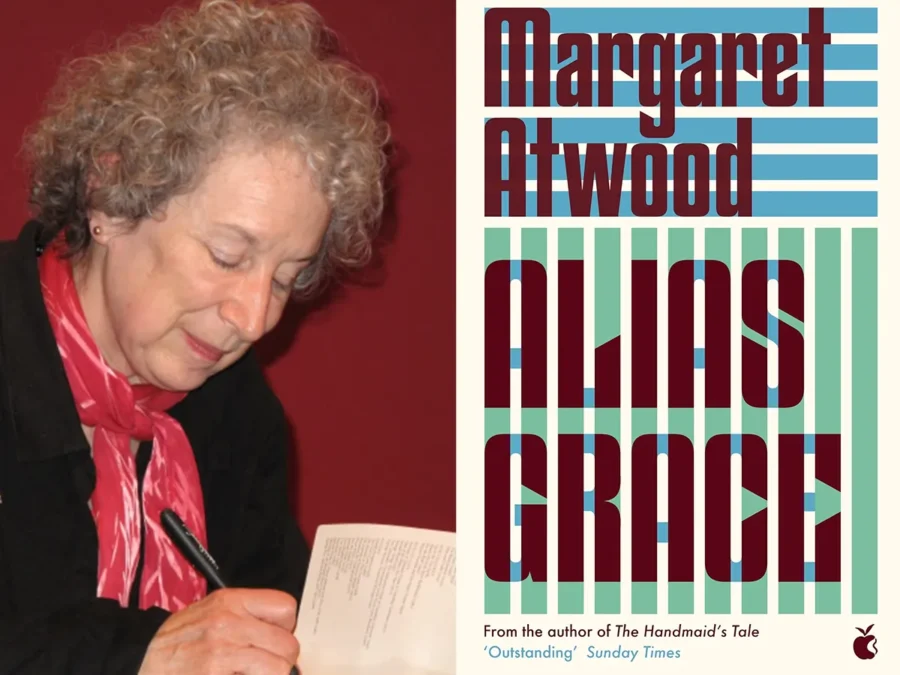

Margaret Atwood takes us into the life of a servant accused of murdering her employer in 19th-century Canada.
When readers don’t enjoy a book, they often complain in reviews that the characters weren’t likeable or that they couldn’t identify with them. Alias Grace by Margaret Atwood is a good example of how a novel can be successful even when the main characters are very hard to like.
The story fictionalises the life of Grace Marks, a notorious real-life double murderer from 19th-century Canadian history. In fictionalising her story, Atwood doesn’t make her innocent of the crime, nor does she make her a particularly sympathetic character in the main action of the novel, which occurs almost two decades later. Grace tells her story, but she also withholds much of it, and she makes little effort to win sympathy for her cause.
The other main character is Simon Jordan, a young psychiatric doctor who interviews her and attempts to understand whether she is sane or insane and whether the gaps in her memory are genuine or a ploy to evade guilt. He is also far from likeable—despite claiming he wants to help Grace, he is really looking to make a name for himself, and he disappears when he realises that won’t be possible. He is also quite heartless in his dealings with two other women in town: his lonely and desperate landlady and a young woman who flirts with him, both of whom he leaves in the lurch when he skips town. His letters and internal monologues don’t paint him in a much better light either, with self-pitying talk about how he lacks a heart and is “doomed to wander lonely as a cloud” being interspersed with the occasional rape fantasy.
And yet the novel works. We read on, wanting to know what happens, not because Atwood has made the characters likeable but because she has made them real. She has shown us their flaws, their histories, and helped us to understand what made them who they are.
In the case of Grace, the context makes her actions easier to understand, whether she was guilty or not. We hear about her childhood of grinding poverty in Ireland, made worse by her father’s drunkenness. The family emigrates to Canada for a fresh start, but her mother dies on the voyage, leaving Grace to try to keep her siblings alive in Toronto as her father continues to squander what little money they have.
Then she goes out to work at the age of 12, working as a servant in various households among the local gentry. In this hostile world, she has one close friend, Mary Whitney, a fellow servant who becomes pregnant after sleeping with the son of the household who is on vacation from Harvard. The man tells her he loves her and promises her a gold ring, but when she tells him she’s pregnant, he gives her five dollars and tells her he will ruin her if she talks:
“He said she would not catch him that way, and he doubted that it was even his own child, since she’d been so obliging with him, that he suspected she had been so for others; and if she threatened him with a scandal, or went to his family, he would deny it, and ruin whatever reputation she had left; and if she wanted a quick end to her troubles, she could always drown herself.”
Unfortunately, this isn’t the man Grace murders. Instead, it’s Mary Whitney who dies after a botched back-street abortion. The whole affair is hushed up, and Grace quickly moves on to work for a new family, and then several more, until a couple of years later she leaves Toronto and goes to Richmond Hill, which is now part of the metro area but at the time was a remote rural location.
It’s at this new house that the murders take place, with both Mr Kinnear and his housekeeper/lover Nancy Montgomery found dead in the cellar, while Grace and her alleged accomplice James McDermott are apprehended trying to flee south to the USA.
What’s interesting about Alias Grace is not who killed Mr Kinnear and Nancy or even why they did it. It’s the exploration of Grace’s life, and all of the injustices of class and gender that are stacked up against her before her life has even begun.
In the background of the novel is the Rebellion, which took place a few years before the murders. As Grace puts it:
“It was against the gentry, who ran everything, and kept all the money and land for themselves.”
There’s no suggestion that Grace committed the murders out of any political motive, and Kinnear himself is presented as a kind man who treats her well. But the repeated references to the Rebellion throughout the book, combined with the details of Grace’s life such as the death of Mary Whitney, remind us of the context of deep inequality in which she lives. It doesn’t justify murder, but it does help to make her a more sympathetic character.
We also have just enough doubt to cling to. The evidence against Grace seems overwhelming, but Grace claims not to remember anything of what happened that day, and some people believe that she cannot be held responsible for something that occurred when she wasn’t truly present or conscious.
The title Alias Grace contributes to this sense of doubt over Grace’s identity and culpability. What does “alias” mean, after all, since Grace is her real name? We get a possible explanation in a strange hypnotism event later on in the novel, which suggests Grace was possessed by the spirit of Mary Whitney at the time of the murders.
However, the credibility is undermined by the fact that the “doctor” who conducts the hypnotism is an old friend of hers who has constructed a new career as a kind of circus clairvoyant. In fact, the credibility of her entire narrative is questionable, as she frequently withholds information and shapes it for effect. It’s very hard to know what to believe.
And yet I kept reading, not because I liked Grace or Dr Jordan or any of the other characters (I think the only person I liked in the whole book was Mary Whitney), but because Margaret Atwood had constructed a fictional world that was interesting and real, and had made me care about the fates of some not very likeable people in a fictionalised version of the distant Canadian past. That’s what good writing is all about.
This post is my contribution to Margaret Atwood Reading Month, kindly organised each November by Marcie of Buried in Print. It runs until the end of the month, so you still have time to take part if you want to. Check out Marcie’s page for more Atwood reviews, and you could also read my post on Cat’s Eye from last year’s event.



There is 1 comment
I didn’t know about Margaret Atwood month.
I love your line, “because Margaret Atwood had constructed a fictional world that was interesting and real, and had made me care about the fates of some not very likeable people in a fictionalised version of the distant Canadian past.” It drives me crazy when friends say characters are unlikable or they can’t identify. That’s the whole point of fiction: to understand characters and motives. As long as they’re believable, an author has succeeded. As usual, sounds like Atwood did that well.