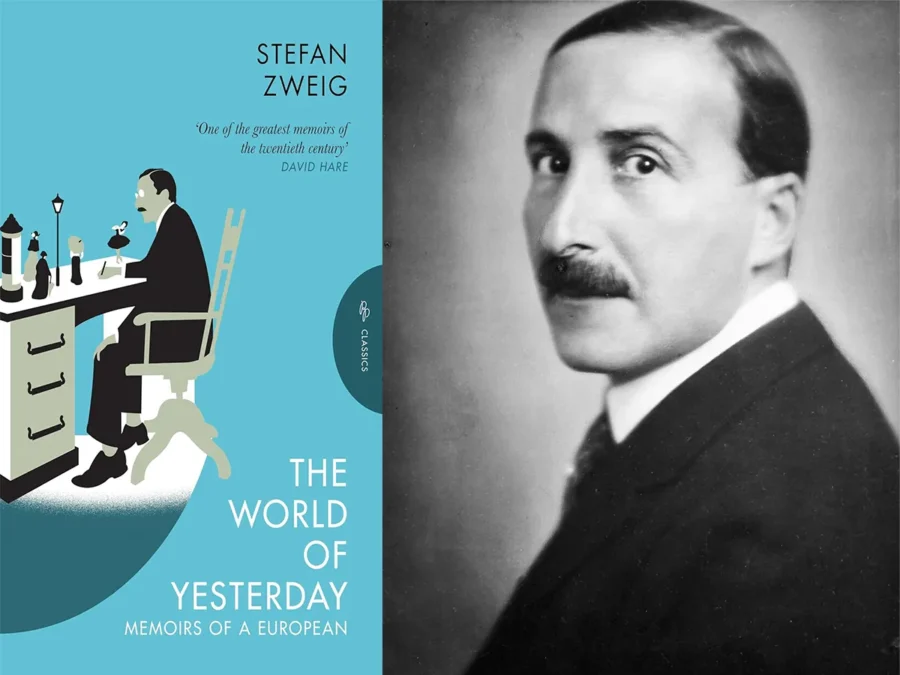

This might just be the best book I’ve read all year. The World of Yesterday is Stefan Zweig’s last book, a beautiful and achingly sad memoir that reads like a eulogy for the cosmopolitan European culture that Hitler was destroying as the book was being written.
We start in the old world of 19th-century Vienna, which had been ruled by the Habsburg Empire for a thousand years and seemed set to stay the same for a millennium more. Zweig watches his father and grandfather living stable lives defined by cautious investment and careful accumulation of wealth. Civil servants, he says, could consult a calendar to see the dates when they would be promoted and would retire. The newspapers carried stories of various wars and crises, but nothing seemed to disturb the unchanging course of middle-class Viennese life.
Zweig grew up to live through a very different era, defined by two devastating world wars, economic devastation, and the Holocaust. Every single certainty he had grown up with was shattered, sometimes multiple times. His books were banned in Germany because he was Jewish, and he was forced into exile first in England and then Brazil.
First came World War I, which brought death on an unimagined scale and also spelled the abrupt end of Habsburg rule and of the vast Austro-Hungarian Empire itself. In the remnants of that dismembered empire, which had been so well-ordered and prosperous only a few years earlier, people now looted and smuggled to avoid starvation. Hyperinflation destroyed wealth and, with it, any sense of certainty or trust in the future.
Then, just as Austria began to recover from that devastation, there was the rise of Hitler, the spread of fascism and violence, and finally the disaster of another war and mass anti-Semitic violence. Writing from Brazil in 1942, Zweig may not have been aware of the full scale of the Holocaust, but he does chart some of the smaller acts of brutality. After the Nazis took Vienna, for example:
“Devout, white-bearded Jews were hauled into the synagogues by young men bawling with glee, and made to perform knee-bends while shouting “Heil Hitler!” in chorus.”
Zweig’s elderly mother was stopped from resting on a park bench because under Nazi rule, benches were only for Aryans. She finally died without family at her side because the nurse attending her was not legally allowed to stay under the same roof as a Jewish man.
All of this comes after many chapters in which we see Zweig becoming a central figure in European culture. He describes meetings with Rodin, Freud, Rilke, Joyce, Wells, Shaw, Ravel, Strauss and many other famous figures. His books sell millions of copies, and his articles, librettos and translations are in demand. In other hands, these descriptions of his success might have sounded like bragging or name-dropping, but Zweig is very clear about his reasons for including this material, and they have nothing to do with self-aggrandisement:
“Understandably, I feel uncomfortable about mentioning the success my books enjoyed in the outside world, and in a normal situation I would have left out even a fleeting mention that might be interpreted as self-satisfaction or boastfulness. But I have a particular right, even a duty, not to hush up this part of the story of my life, for that success has become a thing of the past in the last seven years, since the advent of Hitler.”
Zweig describes his books being banned, former friends not daring to write to him or acknowledge him publicly, his loss of the Austrian citizenship he was born with, being cast adrift into life as a stateless person being forced to beg for admittance to other countries. And lurking in the background of The World of Yesterday is the knowledge that Zweig and his wife died by suicide shortly after he posted the manuscript to his publisher. He really did lose everything, so his descriptions of success and fame are always tinged with the sadness of what was to come.
“I am now a writer who, as Grillparzer said, ‘walks behind his corpse in his own lifetime.'”
As Zweig writes of Hitler’s rise to power, we can’t help but read it with our knowledge of the later consequences in mind. At the time, however, people couldn’t conceive of horrors like the Holocaust, so they continued to live their lives and believe things would get better, even late into the 1930s.
“It is difficult to rid yourself, in only a few weeks, of thirty or forty years of private belief that the world is a good place. With our rooted ideas of justice, we believed in the existence of a German, a European, an international conscience, and we were convinced that a certain degree of inhumanity is sure to self-destruct in the face of humane standards.”
Beyond the broad sweep of the narrative, The World of Yesterday has so much to recommend it in the details. Zweig is a careful observer and has a great way of describing scenes and conversations, so that many of them will stick with me for a long time.
One standout was his description of Rodin giving Zweig a tour of his studio and becoming so obsessed with fixing tiny flaws in his latest sculpture that he forgot his young guest was there. I loved his depiction of his Viennese schooldays, in which the lessons themselves were turgid but he and his fellow students gorged on the latest poetry, plays, novels, concerts, operas and exhibitions.
Then there were little details like the fact that he travelled all over Europe and as far as India and America before 1914 without needing a passport. Border controls seem like a fact of nature these days, but they’re a relatively recent invention. Also, Zweig noticed that when Hitler was still an impoverished beer-hall rabble-rouser, his thugs were marching around with expensive uniforms, weapons and equipment. He saw the same thing on his visits to both Italy and Spain in the very earliest days of the fascist ascendancy. When writing of Franco’s rise in Spain, he asks a very good question:
“Who had supplied and paid for them? There was a new power here aiming to seize government in the country, and the same power was already at work in other places, a power that was not averse to violence, actively called for violence, and regarded all the ideas we valued and for which we lived, such as peace, humanity, reconciliation, as outmoded weakness.”
I think our histories are often quite simplistic, presenting World War II and the Holocaust as the products of a single deranged mind. We don’t pay nearly so much attention to the people who enabled him and other fascist leaders to get from provincial beer halls to positions of such power that they could inflict their warped visions on the entire world. That, perhaps, blinds us to the ways in which this kind of thing could happen again.
For me, the contemporary resonances in The World of Yesterday were painfully obvious as I was reading. Most of us, of course, have not experienced anything like the horrors Zweig describes, but we are seeing democratic norms being eroded in many countries, international law being dismissed as outmoded weakness, authoritarian rule on the rise, scapegoating of minority groups, propaganda fuelling hatred, and so on. One of the lessons of Zweig’s wonderful book is that if you ignore these warning signs for too long, your known world can change so abruptly that by the time you wake up to the need for action, it’s already too late.
I read this book for German Literature Month, being hosted this year by Caroline and Tony. Please visit their sites for more reviews and celebrations of German literature, and you can read some of my past contributions dating back to 2011.