
Can God change the past? If so, how would it affect our memories? This is the central question that Jorge Luis Borges explores in his story “The Other Death”.
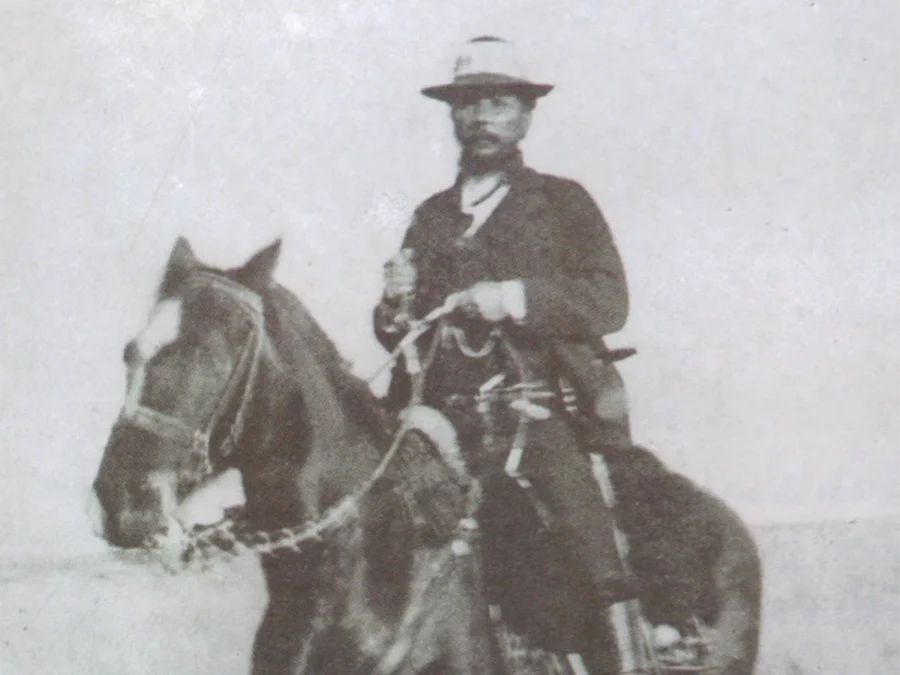
The story concerns Pedro Damián, whose recent death the narrator hears about in a postscript to a letter. The narrator decides to write a story about him, but he only met him once and can’t remember his face or find the one photo he has of him. So he goes to meet a man who did know him: an army colonel who was Damián’s commander in the Battle of Masoller about 40 years earlier. He is disappointed to discover that Damián was a coward.
Absurdly, Col. Tabares’ version of the events embarrassed me. I’d have preferred that they not have taken place quite that way. Out of the aged Damián, a man I’d had a glimpse of on a single afternoon, and that, many years ago, I had unwittingly constructed a sort of idol; Tabares’ version shattered it. Suddenly I understood Damián’s reserve and stubborn solitude; they had been dictated not by modesty, but by shame.
However, the next time he visits the colonel, he has a guest with him who remembers Damián as a young man dying a heroic death at the Battle of Masoller, not a coward who lived quietly and died 40 years later. And on this visit, the colonel has no memory of Damián at all.
Later, the man who wrote that letter bringing news of Damián’s death has also forgotten Damián’s existence. The colonel, meanwhile, now remembers him as a hero.
I think that earlier mention of preferring events not to have taken place quite that way is important because soon things get much more complicated, and it’s not clear which way they happened at all. Is the narrator of “The Other Death” perhaps changing events to take place the way he would have wanted? Is he giving Damián the heroic narrative he prefers?
The references in the story suggest, however, that it’s not the writer but God who is changing the course of history. The original postscript in which he learned of Damián’s death was part of a letter about the poem “The Past” by Ralph Waldo Emerson. In this poem, Emerson says the past is fixed and can’t be changed even by God:
All is now secure and fast;
Not the gods can shake the Past.
Borges, however (or the narrator, if they’re different) tells us of a different theory posited by the medieval theologian Pier Damiani, who wrote in De Omnipotentia that God can change the past. Pier Damiani, of course, is a very similar name to Pedro Damián, and Borges adds a further note of uncertainty:
I suspect that Pedro Damián (if he ever existed) was not called Pedro Damián, and that I remember him under that name in order to be able to believe, someday in the future, that his story was suggested to me by the arguments of Pier Damiani.
It seems, then, that the story is an exploration of what would happen if God did change the past. Perhaps, Borges says, Pedro Damián behaved like a coward and always regretted it; on his death, God granted him the request he’d always prayed for—he changed the past so that Damián died a hero in his youth.
But what of all the people who saw him behave like a coward and remembered him as an old man? The confusion and forgetfulness are part of the process of adjustment to the new reality. The writer himself is part of this process, as Borges hints at in that passage in which he doubts that Damián existed and admits to “false recollections.”
Overall, I loved “The Other Death”. At first, there were a lot of details of battles and wars with references to the footnotes, and I thought it was going to be a historical story. But as the multiple conflicting memories of Pedro Damián’s life and death began to appear, I found myself drawn into the story. In some ways, it’s a fictional version of a thought experiment, in the same vein as “Tlön, Uqbar, Orbis Tertius“, “The Secret Miracle” and other Borges stories. But it’s also a satisfying story to read, as you want to find out what on earth is going on and how all the contradictions can be resolved.
This post is part of my Borges Marathon, a slow and perhaps never to be completed journey through the collected fictions of Jorge Luis Borges.