

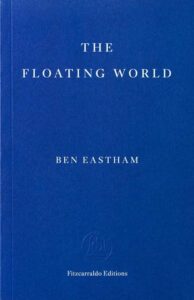
My take on a debut novel set in a near-future European society on the brink of collapse due to climate change and pandemics, in which a freelance art critic gets co-opted into a billionaire’s attempt to build his own separate world.
I was drawn to this novel because the title reminded me of An Artist of the Floating World by Kazuo Ishiguro, which I reviewed on this site almost 18 years ago. As it turns out, the two novels couldn’t be more different, but they do share the same central theme of the role of art in a troubled world.
The differences, I think, are illustrative of our societal direction of travel. In both novels, artists live through times when the world seems to be falling apart. For Ishiguro, it’s the rise of militarism in 1930s Japan that would lead to the disaster of World War II, and for Eastham, it’s the disintegration of Europe in a near-future dystopia riddled by pandemics and out-of-control climate change.
The “floating world” of Ishiguro’s novel is the nightlife of Tokyo, a transient and ephemeral world that the artist tries to fix on the canvas. Ben Eastham’s Floating World is very different: a vast dome being constructed on a Greek island by an evil billionaire as a refuge for him and a super-rich minority against the ravages of climate change. This Floating World is intended to be permanent, while the civilisation around it comes to look increasingly fleeting. It’s a kind of Noah’s Ark designed to preserve a libertarian-tech-bro version of human society from the floods to come.
Ishiguro’s narrator, Masuji Ono, made a conscious choice to side with fascism and devote his artistic skills to patriotic propaganda. Looking back on those times, Ono has this to say about his culpability (or lack thereof):
“There’s no need to blame ourselves unduly. We at least acted on what we believed and did our utmost. It’s just that in the end, we turned out to be ordinary men. Ordinary men with no special gifts of insight. It was simply our misfortune to have been ordinary men during such times.”
Eastham’s narrator is also an ordinary man with no special gifts of insight. He accepts a job on the Floating World, helping with the research and preparations for a major exhibition being staged by a famous artist to give the doomsday bunker some good PR. He needs the money, and he’s been depressed and stuck in his life since the death of his wife several years earlier.
After that, the plot happens to him despite his valiant attempts to remain oblivious to it. The plot is quite intricate, involving a secret smuggling ring to help refugees cross the Mediterranean, a conspiracy against the Floating World itself, and even some surprising connections to his dead wife, but he plays no role in any of it except to stumble around, get the wrong end of the stick and occasionally balls things up.
I found his passivity and lack of agency quite frustrating, but it’s probably a fair reflection of the times. Back in 1930s Japan, Ishiguro’s antihero enthusiastically waved the flag and deliberately used art to support a cause he genuinely believed in, no matter how disastrous it turned out to be. Today, many of us are sleepwalking into fascism and climate catastrophe while doing little to drive the plot. Many activists are fighting and risking everything, but too many of the rest of us are letting climate change happen to us, letting art and creativity be co-opted. I include myself in this: here I am reviewing literary novels, when a far more appropriate response to the times we are living in would be to glue myself to an airport runway.
The Floating World‘s author, Ben Eastham, is an art critic for The Guardian and other publications, and he is very good at satirising the art world’s unique combination of hypocrisy, pretentiousness and cynicism. For example:
“Next to me was a painter whose market value had for years been inflated by the assumption that he would imminently overdose, creating a demand that would be advantageous to his collectors.”
“I followed him up a winding marble staircase to a third-floor corridor lined with people wearing black jeans and black boots or vintage sportswear. By virtue of their determination to look different, artists look much the same everywhere.”
“Knowing better than to be cornered by a performance artist, I hurried out of the room. In the kitchen a topless man was striking a brass gong with the heel of his hand. His movement through the room created a press that pushed me into a young woman with small ears and a young man with a tattoo of a fish on his wrist who was saying that the work described a profundity which must be outside of words. She responded by telling him to shut the fuck up, Michael.”
“The gallerist went over to engage the women in conversation about the colonisation of time by late capitalism and the competitively priced drawings that illustrated this phenomenon, which could be purchased individually or as a series.”
There are also some interesting uses of artistic terms in descriptions. I still can’t quite visualise the first one, but overall I found them a nice touch:
“The police on the street below me appeared foreshortened against their shields, like inverted putti.”
“a mahogany motorboat like a Venetian water taxi bobbed on the grisaille sea.”
“a cosmatesque pattern in sound.”
“I was looking out over the town like some self-consciously melancholy Rückenfigur.”
Beyond the art world, though, The Floating World is also a book about connection. Events are connected, even when we don’t see the connections ourselves. The billionaire’s island refuge is an attempt to sever those connections and create a world in which he and his friends are safe as the rest of us burn. Meanwhile, our narrator searches for connections everywhere from Renaissance art to the patterns in a motorboat’s wake, while spectacularly failing to see the ones in front of his eyes.
“If I could only read what was written into the world, I thought, then I might better understand how to move through it.”
His friends in London don’t seem to have the same difficulties—they join strikes and protests against the system that is bringing about their downfall. But he is looking for something different, something deeper. Would it make a difference if he found it? Probably not. Despite his moral qualms about the Floating World, he stays in it, doesn’t fight against it in any meaningful way, and at one point pitches the billionaire with an idea of how he could stay in it full-time after his contract ends. As Roland Barthes says in the book’s epigraph, “I look for signs, but of what?”
Thanks to Fitzcarraldo Editions for the review copy of The Floating World by Ben Eastham, which will be published in the UK on 8 October. Unusually, although Eastham is a British writer, it looks as if the US edition was launched slightly earlier, by Astra Publishing House.

There are 4 comments
wow, reminds me a lot of Weaver’s fabulous novel: Artificial Wisdom: https://wordsandpeace.com/2025/11/21/book-review-artificial-wisdom/
Interesting! I can see the parallels, although this one is less of a thriller and has less sci-fi about it. It actually feels more contemporary than futuristic – I think the near-future setting is just to bring the consequences of climate change into a sharper focus by moving things along a bit on the track we have chosen.
I think reviewing books like this is much more useful than gluing yourself to an airport runway because you reach more people this way who may experience an epiphany and be shaken from going along into doing something.
I love it when you have a connection between two books (even if it is just a title, which the authors might not even have chosen for themselves… could be that an editor was choosing to highlight marketability, who knows?) because it brings up all sorts of compare and contrast opportunities and helps you think more deeply about both works. Ishiguro is someone whose work I’d like to read completely but I think I’ve actually only read… three maybe? The newer floating world sounds very thought provoking and I’m betting you were meant to be frustrated at those parts! Frustrated enough to do something about it.