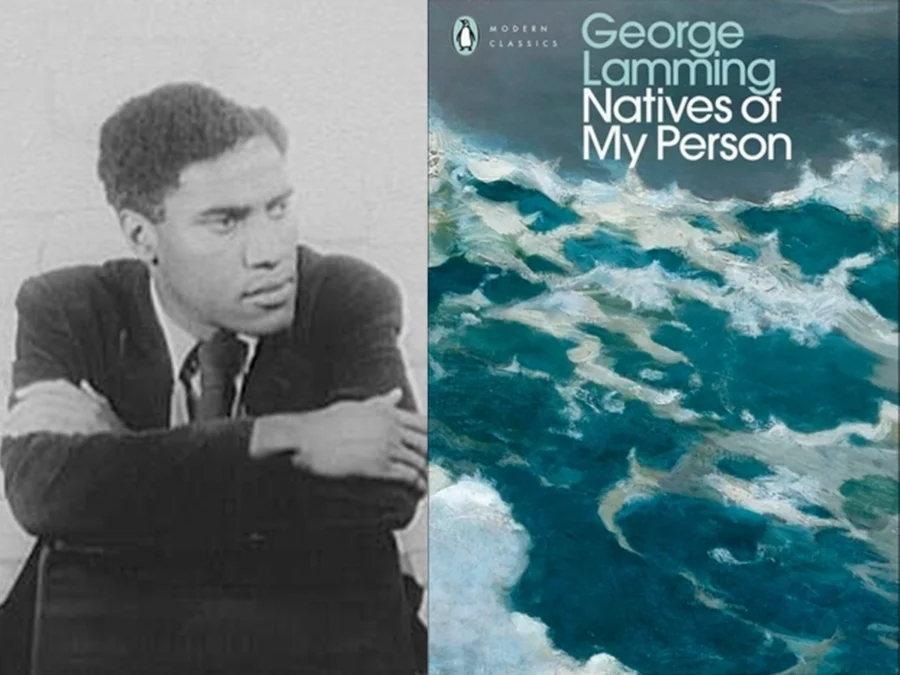

My review of Barbadian novelist George Lamming’s complex allegory of colonial psychology.
I don’t often enjoy or agree with the introductions people write to novels. I usually read them after the novel itself because I don’t want to read with someone else’s expectations in my head, and when I go back at the end to read them, I often don’t find they illuminate much.
In the case of Natives of My Person, however, the introduction by Caryl Phillips perfectly describes what I wanted to say about the book:
“The fine, sinewy prose beautifully illuminates the many ideas about the colonial world and the role of the colonizer which inform the novel; yet the allegorical nature of the novel creates a distance which often militates against the reader’s feeling any real drama.”
I’ve read quite a few books by the Barbadian writer George Lamming, such as In the Castle of My Skin and The Pleasures of Exile, and I saw him speak about the politics of reading at a literary festival in Barbados 16 years ago now. So I knew what to expect from the prose, and Lamming didn’t disappoint.
His style reads as quite old-fashioned these days, more like a classic nineteenth-century novel than a 1970s one, with an omniscient narrator and a heavy dose of detailed physical descriptions. It’s the small, surprising details that I appreciate the most. To take a page at random, we have a very unusual description of the sea’s action:
“The tide quickened and came high up the bow, rubbing its weight against the waist of the ship.”
Then we meet the captain of the ship, who is missing his usual ostrich-feather hat:
“Now his hair was naked and shifty in the wind.”
I’ve never heard hair described as either naked or shifty, but it works perfectly in this context. And the way the tide rubs its weight against the ship’s waist is almost sexual, which again works in context (the ship has been delayed in port for months, and it’s as if the sea is trying to lure them out).
Every page is like this, with words and sentences selected and assembled with great care, each with a very specific job to do.
Then we have the ideas, which, as Phillips rightly notes, form a rich and interesting examination of colonialism. The ship we have encountered is a vessel from the fictional nation of Lime Stone (which bears a striking resemblance to Britain in the age of empire). It embarks on a long voyage to settle the distant island of San Cristobal, which Lamming uses in other novels as a fictional representation of a Caribbean island, although the geography in Natives of My Person is always vague, and the Caribbean or West Indies are never mentioned by name.
The ship contains within it the hierarchies that it will export to the New World, along with the violence and cruelty. The officers and crew repeatedly doubt each other and fear that they’ll be betrayed to the House (a ruling trading company, which reminded me of the East India Company). They vie for favour and power, while functioning within an overall order that demands absolute obedience and submission.
I think this is what Phillips means by the “allegorical nature of the novel”. The ship’s voyage feels like an exploration of what drove European colonisers to do what they did, and how the injustices and inequalities of colonial societies were contained in their very origins.
Natives of My Person is also, I think, a novel about male fragility and the use of violence and bravado to mask that vulnerability. The ship’s crew is entirely male, and several of them have quite disturbing back stories involving women (resenting them, feeling oppressed by them, lying to them, having them committed to mental asylums, etc.). When it emerges later that a ship of women is also making the voyage to San Cristobal, including some of the officers’ wives, it has an interesting effect that I won’t spoil for you here because it’s an important part of the novel’s conclusion.
For many characters, the inability to relate to the women in their lives leads to a kind of emotional stuntedness and repression, which then causes the violence, aggression and lack of empathy that will make them (or men like them) into able colonisers and colonial administrators.
But Phillips is right that the “allegorical nature of the novel” creates a sense of distance. Everything is happening for a reason, but the reasons are to do with what George Lamming wants to say about the psychology of colonisation. The characters themselves are not interesting or compelling, and I often struggled to tell them apart. Many are referred to not by names but by functions (Boatswain, Priest, Steward, etc.), which fits with the theme of individuals being cogs in a colonial machine but doesn’t help the reader care what happens to them.
Also, not much happens on the voyage. There’s a lot of talking and not much action, which is odd for a maritime voyage like this. It’s clear that Lamming would never write an “adventure on the high seas” kind of novel, but I was surprised that a premise like this led to such a slow, dialogue-heavy book.
All in all, I think there’s enough beautiful prose and complex themes in Natives of My Person to make it worth reading (and worth publishing in a new 2026 edition—thanks to Penguin Classics for the review copy). However, if you’re new to Lamming’s work, I’d recommend starting with his beautiful debut novel In the Castle of My Skin.


There are 10 comments
Fascinating author for what you describe here. Since I haven’t read anything by him I would follow your recommendation. That title rings a bell (I have probably read or heard good things about it, I am sure)
Hi Silvia, Thanks for visiting! It’s funny how book titles lodge in your head, isn’t it? I read about books in so many different places that I often struggle to remember where I first heard about it.
I don’t know this author and have read nothing from authors in Barbados, so thank you for introducing me to a new topic and area and era.
You’re welcome! Lamming is widely regarded as the best Barbadian novelist, so if you want to read something from the country, he’s a good starting point, although as I mentioned in the post, In the Castle of My Skin is a better choice.
A lot of talk and not much action doesn’t sound like other ship-voyage novels we may have read, but maybe it’s more realistic in the end? hehe I’ve mentioned somewhere recently that I have lucked into a couple of his books second-hand recently, and I’m excited about that. The language seems quite lovely. For anyone new-to-him or without ready access to purchasing/borrowing, some of his early books (some outofprint even) are available on the Internet Archive if you are able to read books on screen.
Hi Marcie, I hadn’t thought about it, but you’re probably right! Maritime fiction tends to focus on the storms and adventures, but long, slow hours of talking to crewmates is probably more the norm. I remember Orwell’s book Homage to Catalonia really brought that home to me about war – his view of it was less about glory and honour and more about long months of boredom and mud and picking lice out of your pants!
Great that you’ve found a couple of his books second-hand – hope you enjoy them! Which ones do you have?
The Emigrants and In the Castle of My Skin, which I super pleased about, having read the last bit of your review of this one. I’ll keep watching the shop, too, it seems like once an author’s work appears there, more arrive later (assigned reading at the uni and then some students supplement…that’s my guess). I’d like to read Water with Berries too.
Nice! I haven’t read The Emigrants but would like to. It’s great that you’re in tune with the bookshop’s ordering rhythms. Hope more Lammings show up there!
I prefer 19th century writing for its detail and formality. I am trying very hard to read more writers from Africa and the African diaspora, particularly the earlier writers. So Lamming appeals for all those reasons. It seems I can’t ‘cheat’ and get him on audiobook, but then I have read a number of interesting works on Archive.
I thought there was a connection between Lamming and the early post-colonial Africans. Lamming visited ‘west Africa’ in 1958 but otherwise I can’t see anything.
Yes, I think you’d like Lamming, although he might be difficult to find these days in Australia, especially on audiobook. Glad Marcie suggested an online source.
Lamming lived in London in the 1950s and worked for the BBC as a broadcaster focusing on what was then called “colonial literature” but would soon become post-colonial literature. I know he had a lot of contact with other Caribbean writers in that time, and I guess he would have made links with African writers too. That may be the connection you’re thinking of?