
Are our lives really defined by a single moment? And what happens when that moment involves seeing yourself in someone else? Borges answers these questions while telling the story of an outlaw turned lawman.
Borges loves the Martín Fierro epic, and “A Biography of Tadeo Isidoro Cruz” is another retelling of the famous tale, this time from the point of view of a minor character.
This means the story would have a very different resonance for Argentine readers, who would be instantly familiar with the story and would recognise the details as they started to accumulate.
For an English reader like me, who has never read Martín Fierro, the effect is different. I had to dig into the footnotes to understand the historical context and the Fierro references. Without them, the story is a biography indeed, although this being Borges, it’s not a standard biography by any means. He begins by eschewing the very purpose of a biography, to tell the story of Cruz’s life:
It is not my purpose to repeat the story of his life. Of the days and nights that composed it, I am interested in only one; about the rest, I will recount nothing but that which is essential to an understanding of that single night.
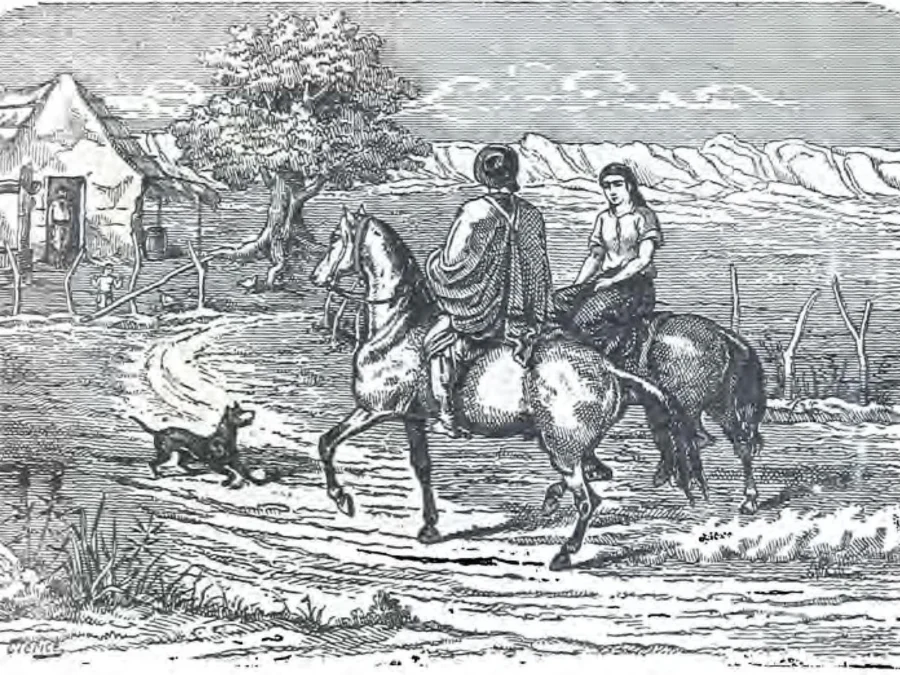
So we get a kind of cursory summary of some of the main events in Cruz’s life: his work as a gaucho, his sudden and senseless murder of another man, his valiant fight and eventual capture, his conscription into the army in lieu of a prison term. Then we skip forward to the night Borges is interested in, the moment that defines him:
Any life, however long and complicated it may be, actually consists of a single moment —the moment when a man knows forever more who he is.
I don’t really agree with this—I believe in multiple moments, multiple opportunities to know who you are and to evolve and become who you want to be. But perhaps that’s more of a contemporary notion; in any case, Borges’s idea of a single defining moment makes for a good story.
As Cruz approaches his defining moment, a strong sense of deja vu creeps into the story. He and his men are chasing an outlaw who’s wanted for murder, and the whole episode echoes his own flight from the law and subsequent capture decades earlier. He realises that, although he’s now on the side of the law, his true nature is to be the outlaw he is pursuing.
He realized his deep-rooted destiny as a wolf, not a gregarious dog; he realized that the other man was he himself.
That idea of a character recognising himself in others occurs in other Borges stories. It hints at our deeper connections beyond the superficial things that divide us, but it’s also connected with Borges’s fascination with mirrors, infinite duplication, and repeating patterns throughout history. We enter a kind of infinite recursion, where Cruz is both the pursuer and the pursued, and we start to wonder how many times and in how many ways this episode has already occurred and will occur again.
This made it a satisfying story for me, even though I missed a lot of the historical references and the Fierro rewriting. The big realisation for people familiar with the epic would be that the man he’s pursuing is Martín Fierro himself, and the ending is a famous moment in the epic when Cruz abandons his men and joins forces with the outlaw. In Martín Fierro, the episode is told from the hero’s point of view, but in “A Biography of Tadeo Isidoro Cruz”, we approach it from an entirely different perspective.
This concept of switching sides is also reminiscent of other Borges stories such as “The Shape of the Sword” and “The Theme of the Traitor and the Hero“, while the rewriting of Martín Fierro is a technique he also uses in “The End“. For more details on Borges fictions, check out other posts in my Borges Marathon, a slow and steady reading of all 100+ stories by Jorge Luis Borges.
There are 7 comments
Every time I read one of your Borges posts I think to myself that I really MUST get one of his books down from the shelf (I confess I own two and have read neither). And I really will do it – one of these days! Such an interesting and insightful glimpse into this particular story and the world of Borges, Andrew.
That’s good to hear, Victoria! Although I think you’ve said that before, so my posts can’t be persuading you strongly enough. Must try harder 🙂
Borges is really a far cry from Dickens, who starts David Copperfield as follows:
“Whether I shall turn out to be the hero of my own life, or whether that station will be held by anybody else, these pages must show. To begin my life with the beginning of my life, I record that I was born (as I have been informed and believe) on a Friday, at twelve o’clock at night. It was remarked that the clock began to strike, and I began to cry, simultaneously.”
In fact, he is a bit closer to Holden Caulfield in Catcher in the Rye, although maybe not quite so sarcastic:
“If you really want to hear about it, the first thing you’ll probably want to know is where I was born, and what my lousy childhood was like, and how my parents were occupied and all before they had me, and all that David Copperfield kind of crap, but I don’t feel like going into it, if you want to know the truth.”
I enjoyed these comparisons, Richard! I don’t think Borges has been compared to Holden Caulfield very often, but you’re right—translate the 50s American slang into a more literary register, and you pretty much have the opening of this story. What I like about the Borges version is that he calls his story a biography and then pretty much immediately says, “This is not a biography…”
What an interesting story. I feel like it echoes another story you wrote about that I can’t recall. But also, it might seem familiar because of Borges’ fascination with mirrors, patterns, etc. How many stories have you read now and how many do you have to go?
Yes, a lot of Borges stories explore similar themes of repetition and mirroring etc. I’d like to draw all the connections, but this project is so slow that I often forget prior stories myself! As for the progress, I’m at about 30%. I can’t remember the exact number of stories in total, but I think it’s around 100. So it really is a marathon!!
Hi, I have started in order but I have also jumped ahead to read the 13 stories that were published in 1949 as The Aleph. Chris in Calmgrove has blogged about them and thanks to him and to you, I can understand what I am reading. I have not read Martin Fierro either but I like the philosophical concept explored here of a person being on two sides and in conflict with himself. I believe I have been on many two different paths in life, just not at the same time-atheist, believer, mother-daughter, law breaker-law abiding, left-right, homeschooler-school teacher. I think Borges would love to see how we, after reading his work, are collectively trying to explore their meaning, references and have a conversation with them and with him.