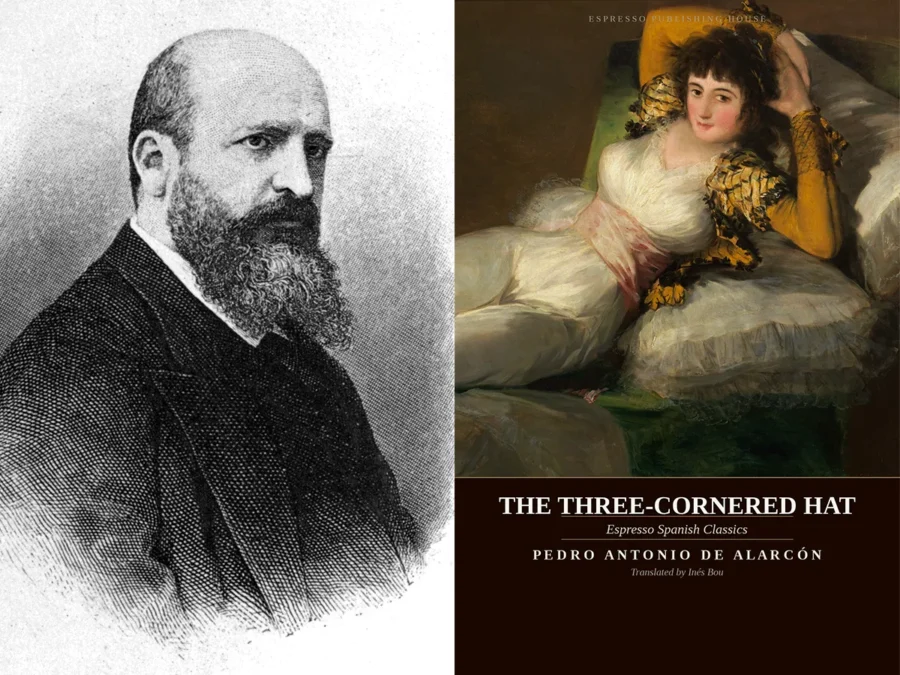

In this 19th-century Spanish novella, a miller and his wife have their love tested by the scheming of a corrupt local authority figure.
In this age of divisiveness, one thing unites us all: a total mistrust of the people who rule over us. This is borne out by academic research, but I also saw it first-hand as I travelled to dozens of countries from the Arctic to the Sahara and from South America to the South Pacific. Everywhere I went, people told me the same thing: it doesn’t matter who’s in power because they’re all as bad as each other.
What does all this have to do with a nineteenth-century Spanish comic novella? Well, at the heart of The Three-Cornered Hat is the Corregidor, a corrupt authority figure who tries to use his power to seduce another man’s wife, among other vile acts. He writes a letter to grant the woman’s nephew a plum job and then issues orders for her husband to be arrested so that he’s out of the way.
But it’s not just the Corregidor: everyone in authority in the novel is corrupt, dishonest or hypocritical in some way. The Corregidor’s assistant, Garduña, is named after a small Spanish mammal known for its cunning and speed. The village mayor happily goes along with the Corregidor’s plan, after he has drunk a jug of wine and administered his wife’s daily beating. The village constable is also a drunkard, and the clergymen, lawyer and other notables are all flawed in some way.
The Three-Cornered Hat, then, is a novel that has a lot to say about the times we are living in, when a convicted felon can launch a war to divert attention from the fact that his name comes up more than a million times in the Epstein files. The Corregidor is a small, petty man who uses the power embodied in his three-cornered hat to make himself feel bigger. No matter where we live, I think we’ve all probably encountered someone like that.
Thankfully, the novel doesn’t centre on the Corregidor. The main characters are the miller, Lucas, and his wife, Frasquita. They live just outside the city and regularly entertain the most powerful men on their afternoon strolls, plying them with food and wine in exchange for favours. Although they are not rich, it is worth it to them to give these men free food and hospitality.
“In times when more than fifty different levies were owed to Church and State, a rustic of such clear intelligence had little to lose by keeping the goodwill of aldermen, canons, friars, notaries, and other persons of consequence … Tio Lucas saved himself a fortune each year through his policy of entertaining everyone.”
The Corregidor’s attempt to seduce Frasquita by presenting himself honestly as a man in love with her is a disaster: she contemptuously rebuffs him (the chapter is cleverly called “The Bombardment of Pamplona” in reference to the city’s renowned fortifications). So he comes up with a new plan that depends not on his person but on his power alone.
As the plot advances, the book becomes reminiscent of a classic opera buffa, with much changing of clothes and misunderstandings that are resolved in the end to the benefit of the virtuous and the detriment of the evil. The drama shows people in their true colours, and it’s those without power who are revealed as superior in virtue to those who in daily life are superior in status.
If that sounds like the ending of a folk tale, that’s because this novel is indeed based on a traditional Spanish folk tale—the novel begins with an account, which may or may not be true, of how Alarcón (or his narrator) first heard it.
However, The Three-Cornered Hat is also more than a folk tale. Alarcón brings in carefully observed details of the period to make subtle points about social classes and their values, and the translation faithfully either renders those details into English or leaves them in Spanish with a note to explain their significance. In a few places, these notes veered too far into explanation for my liking, spelling out details of the plot or of Alarcón’s jokes that were either obvious or that I would have preferred to work out by myself. Mostly, however, they were helpful in detailing the meaning of particular subtleties of dress and behaviour that would have been obvious to a nineteenth-century Spanish audience but meant nothing to me.
I’m always a bit suspicious of comic novels because I never seem to laugh out loud while reading a book in the same way as I do when watching a movie or a stand-up comic. However, I did find this book funny—not in a “laugh out loud” way but in appreciation of the satire, the absurd situations, the ridiculous pomposity of the minor officials who act as if they are the King of Spain.
It’s also a folk tale told in a sophisticated literary style, with symbols and foreshadowing scattered throughout. One great use of foreshadowing is when Lucas and Frasquita jokingly talk about what would happen if the Corregidor succeeded in seducing Frasquita, and Lucas says he doesn’t know what he would do because he would be a different person then—his whole life is built around his faith in her.
“I am now a man who believes in you as in himself, and has no more life in him than this faith. If I stopped believing in you, I should die, or become a new man; I should live in a different way; it would seem to me that I had just been born…”
This is a light-hearted conversation at the time, but it takes on a new light later on, when in all the confusion and misunderstandings, Lucas does stop believing in his wife for a time, and he does start behaving like an entirely different person.
Overall, I’d recommend this short novella as a quick, light-hearted story that also has plenty of depth for those who want to look for it. The Three-Cornered Hat is published by Espresso Publishing House, a new publisher based in Calgary that’s dedicated to “beautiful new editions of overlooked European fiction.” That sounds like a great premise to me, so I was happy to accept a review copy of this, their second published book.

There are 12 comments
Ooh this is a new publishing house to me and an intriguing one. I don’t know whether to laugh or cry, though, at the endless perfidy of authority figures. You’d think that surely, at some point, we’d have enough experience to ensure that we elect ethical people to high office, wouldn’t you? No, don’t answer that – the evidence is all too clear to see…. Beautiful review, Andrew.
I think laughter is always the better policy, but it’s not always easy to maintain. Alarcon helps us laugh at the Corregidor, but it’s almost worse these days, when we actually vote for these people. Then we participate in the perfidy and have to laugh at ourselves too, which is harder.
Oh this sounds like a delightful read! I hope the new publisher has great success!
It’s a good one, Stefanie. Yes, always good to see a new niche publisher coming on the scene, despite all the doom and gloom about how nobody reads any more.
I really enjoyed this review because it highlighted how a classic novel can still feel surprisingly relevant today. The connection between satire, abuse of power, and human nature makes me want to move this book higher up my reading list. It’s always satisfying to discover older literature that still speaks so clearly to modern readers.
Thanks, Fenton! Hope you enjoy reading it.
I certainly believe that all western governments are too much under the power of their donors, but I also believe there are degrees of corruption, and that the conventions we once believed would protect us crumble in the face of serious corruption. Luckily, that seems to happen more in other places than it does in Australia.
I never come into contact with officials, corrupt or otherwise, in my daily life, which is a good thing when you read about the pressures put on ordinary people by ICE in the US or on Palestinians by the IDF.
Framing the threat as “I will take your wife” brings it home.
I agree – there are certainly degrees of corruption, and although it’s demoralising when politicians repeatedly represent donors over voters, it’s much worse when the corruption reaches every level of officialdom. When a random official has total power over your future and even your life, that’s very scary. Alarcon captures this well – the Corregidor’s power is very real and threatening, but he softens the impact by making him a figure of fun who is easily outwitted.
What a great match for your reading taste and ongoing projects and interests! And I’m curious to see what the press releases in future too. Your comment about being wary of the use of ‘comic’ rings true for me, too; it often seems to translate into reading with one eyebrow slightly raised and a propensity towards smiling on occasion, rather than actual grins or laughter. (Also, occasionally, a wince. Which is confusing.)
I’m happy to report that your comment raised an actual grin for me, which is more than most comic novels achieve. And yes, The Three-Cornered Hat led to a lot of eyebrow-raising and almost-smiling as I read it, but thankfully no winces that I can remember!
I am proud to see Spain’s classical literature being praised and enjoyed in translation! I am glad to see you have appreciated the satire and critical spirit of the book. It always surprises me -although it should not, because it’s part of the cyclical and universal quality of history and humanity, how modern, fresh and relevant some old titles are. Thanks for a well written review.
Hi Silvia, Thanks very much! I like your way of describing it: “the cyclical and universal quality of history and humanity.” So many things have changed since Alarcon wrote this, and yet it does feel fresh and relevant. Even though it’s a story about a very particular place and time, some of the wider themes about power and corruption have, sadly, not changed much. I think it’s one of the reasons I love both reading and travelling – the ability to learn about very different ways of living and find in them both the new and the familiar.