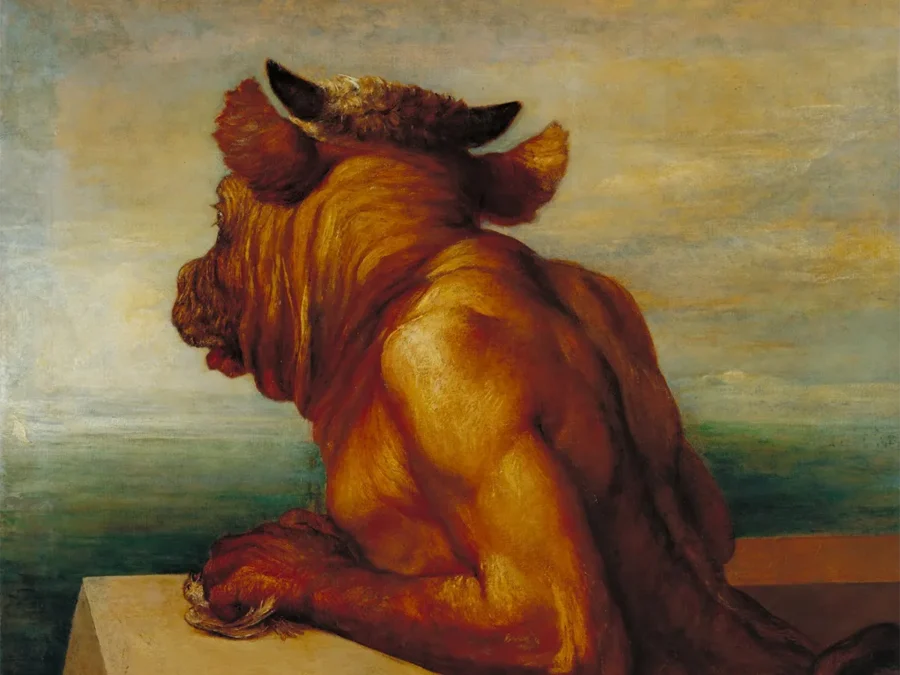

“The House of Asterion” is one of the shortest stories by Jorge Luis Borges, composed almost entirely of the interior monologue of a lonely character who lives in a labyrinth.
It shares several features of other Borges fictions. Like “The Cult of the Phoenix“, it’s a kind of literary puzzle or riddle. In this case, the main point is to guess the identity of the main character, who is a famous mythological character. Borges drops a few hints along the way, like a thread helping us to navigate the literary labyrinth, but it’s not until the final line that he reveals the answer.
Note: I’m going to reveal the answer to the riddle in the next paragraph, so if you’re about to read the story and don’t want to spoil it, look away now!
It’s also a retelling of a famous story from a very unusual point of view, much like “A Biography of Tadeo Isidoro Cruz“, which we read a couple of months ago. In this case, the famous story is the killing of the Minotaur by the Greek hero Theseus. Even for those of us not well versed in Greek mythology, it’s a familiar tale, and it has obvious parallels in other monster-slaying fables from a variety of cultures.
In “The House of Asterion”, Borges chooses to tell the story from the point of view of the monster. The effect is to make us feel sorry for the Minotaur, who bears no ill will to the people around him. When he leaves his labyrinth and is spotted by the inhabitants of the town, he misinterprets the reason for their terror:
“Not for nothing was my mother a queen; I cannot mix with commoners, even if my modesty should wish it.”
The Minotaur doesn’t see himself as a monster, of course—no monsters do. When we inhabit another person’s reality (or another creature’s reality in this case), it becomes impossible to see them as a monster. That is only possible when you view the story only from one side, as we always do with monster-slaying fables. But Borges delights in blurring the lines between heroes and villains (see “The Shape of the Sword“, for example). He helps us to see the world through the Minotaur’s eyes, and we can no longer view the monster’s killing as a simple act of heroism.
Borges writes in his Afterword: “I owe to a canvas painted by Watts in 1896 the story called ‘The House of Asterion’ and the character of its poor protagonist.” When I found the painting online, I could see why.
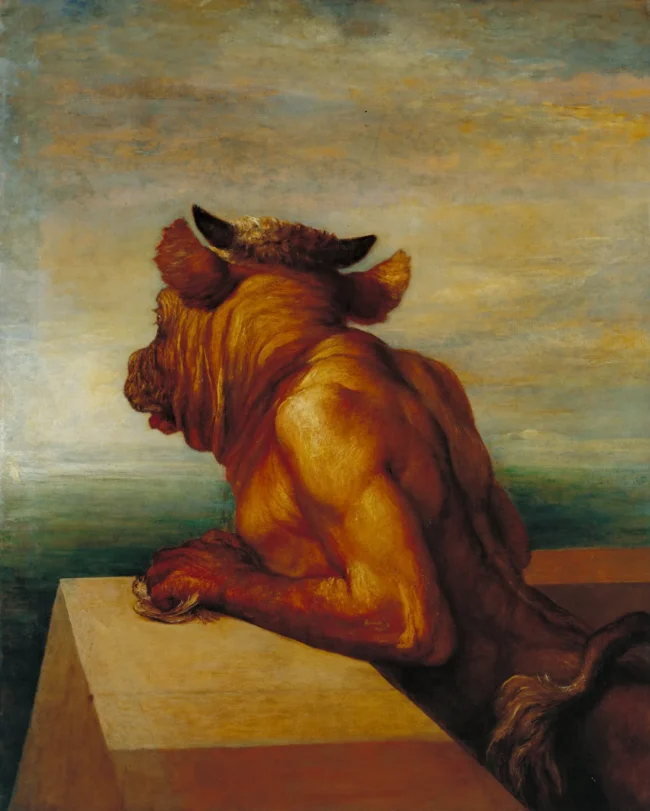
There’s nothing monstrous about this Minotaur. Yes, he does have some kind of dead animal in his grip, but his gaze is fixed longingly on the horizon. The face reminds me of a faithful dog awaiting its owner’s return. We can’t hate or fear this Minotaur. We can’t see him as a monster or feel good about plunging our sword into his defenceless body. I can picture Borges viewing this painting in a gallery or book and feeling the germ of a story begin to take shape in his mind.
Many of the familiar symbols and themes of Borges fiction are present and correct. In addition to the switching perspectives and the blurring of the line between hero and villain, we have the presence of a labyrinth and frequent references to infinity. The Minotaur tells us that the labyrinth has 14 doors, but Borges adds a note from an imagined editor telling us that the number fourteen means “infinite”. (Who this editor is and how this person knows anything about the Minotaur’s language or number system is a mystery that the reader is left to ponder.)
There’s also a religious dimension to the story. The Minotaur views his killings of the young men who enter the labyrinth as freeing them from evil, and he eagerly awaits the arrival of his own “redeemer” who will free him from the solitude of his existence. In a poignant moment just before his death, he ponders the nature of the redeemer, as humans over the centuries have speculated about the form of God:
“What will my redeemer be like, I wonder. Will he be bull or man? Could he possibly be a bull with the face of a man? Or will he be like me?”
When Theseus finally arrives to “redeem” this poor, lonely creature, casually remarking that the creature barely defended itself, we see the killing in an entirely different light.
“The House of Asterion” contains a timeless lesson with strong contemporary resonance. We live in an age when politicians are routinely trying to dehumanise whole groups of people, aiming to make us accept their imprisonment/deportation/slaughter. After all, who wouldn’t want to slay monsters, and who wouldn’t want to celebrate the hero with the bloodied sword? But compassion and empathy for our fellow beings demand of us that we reject simplistic binaries and embrace the more complex truth that Borges shows us: there are no heroes, and there are no monsters. We must make the effort to see the world through the eyes of those we hate and fear. We might be surprised what we discover.


There are 7 comments
Number 33! Already! I don’t know when I started to follow you but I have read several of your Borges posts. I’m going to start with his complete short stories soon. I bought the complete short stories because I saw you writing about them, but it is time this year to start reading them. I’m curious as to how many of your posts about them I will remember. I probably come back and read your reflections on them as I read them to compare notes.
Hi Silvia, Thanks so much for this! Yes, number 33 already, although I wrote number 1 back in 2009, so my progress has not been exactly swift 🙂 I’ll keep going, though, and maybe I’ll get to the end some time in the 2030s. I’d love to hear your thoughts on the stories when you read them – will look out for posts on your blog and would love to see your comments on my reflections if you do read them. It’s always good to compare notes with a fellow bibliophile.
The painting is lovely and so sad. I have always felt sorry for the Minotaur so I appreciate the perspective Borges takes in this story.
It is, isn’t it? I definitely felt sorry for the Minotaur after reading this story. Makes me wonder about all those other monsters that our “heroes” have slain too.
I love how Borges turns a familiar monster story on its head. The Minotaur’s loneliness makes Theseus’s supposedly heroic act feel almost tragic. Your observation about the painting adds another layer to that interpretation. It makes you wonder how many other literary villains might appear sympathetic if we heard their side of the story.
Led here by Silvia (above) I shall now be looking out for your Borges posts if they’re all like this insightful piece! Recently I looked at the works in the original 1949 ‘El Aleph’ collection and found them even more intriguing than I remember them: https://calmgrovebooks.wordpress.com/tag/el-aleph/
Incidentally, regarding the number fourteen representing infinity, I can’t claim to have worked out why but I have some thoughts:
(1) The Athenian ‘youths’ sent to Crete on a regular basis were fourteen – seven males and seven females – and as there seems to be an unending supply of them that could suggest infinity;
(2) The traditional ‘Cretan’ maze, a unicursal labyrinth, had (especially in its squared form) seven paths constantly turning back on themselves going in, and seven out, which seems to me also suggestive.
Neither observation is conclusive, of course, nor would Borges intend them to be I guess!
Chris.
Hi Chris, Thanks for stopping by! I’ll check out your posts on El Aleph. Those two observations on the number 14 are very interesting. I can imagine the Minotaur alone in the labyrinth, with those 14 Athenian youths being the highest number of anything he’d seen. The design of the maze is also a good theory.
You’re right that the term “conclusive” doesn’t make much sense in the world of Borges, where so many things are intentionally obscure or ambiguous, but those two explanations make a lot of sense to me. Thanks!