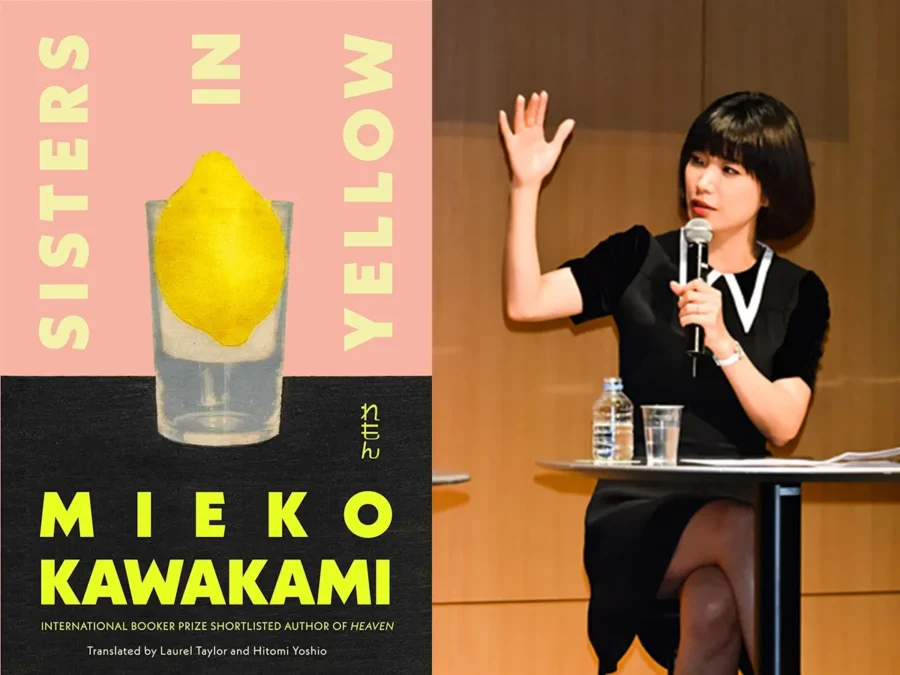

My thoughts on Mieko Kawakami’s latest novel, in which the bland recounting of everyday events conceals deeper themes.
Some books just stay with you, even if you can’t quite explain why. Sisters in Yellow by Mieko Kawakami will, I think, be one of those books. Kawakami has a quiet, understated prose style, and often she’s just recounting banal everyday events, but it all adds up to an immersive reading experience.
The novel is narrated by Hana, a thirty-something woman now looking back on her teenage years. She’s prompted by a news story about a criminal case against 60-year-old Kimiko Yoshikawa, who kept a vulnerable young woman locked in her apartment for two years. Hana also lived with Kimiko for a couple of years when she was young and vulnerable, and someone died. She seems to have blocked out the details, and the novel is her attempt to piece it all together.
We then jump back twenty years, from the early days of Covid-19 to the early days of the millennium, which is where most of the action in Sisters in Yellow takes place. Hana is just 15 years old and living under the absent-minded care of a mother who works in late-night dive bars and lives entirely in the present. When her mother disappears and asks her friend Kimiko to look after her for a summer, Hana starts to see for the first time in her life what it’s like to be taken care of.
So, when she gets a chance to move in with Kimiko later on, she jumps at it. They start a bar together, called Lemon, and it does well. Hana becomes the opposite of her mother, living entirely in the future, working hard and saving every yen she earns. But something always seems to thwart her plans: someone steals her box of cash, her mother needs to be bailed out after getting in debt and falling for a scam, the bar burns down. No matter how hard she tries to build a future, she’s always starting from scratch.
Hana then starts working at a low level within a crime organisation: taking a stack of fake cards that the organisation has created using stolen data, and withdrawing cash from ATMs around Tokyo. She then passes the cash on to her handler, Viv, in exchange for a cut of the proceeds. It’s easy money, and Hana works hard and accumulates more savings to reopen the bar. She brings in two friends, also young and vulnerable in different ways, to work with her and live with Kimiko.
As the money builds up, however, Hana loses sight of the goal of reopening the bar and just wants to accumulate more. She becomes controlling and abusive, creating strict house rules that she claims are necessary to keep them all safe, but her friends become increasingly resentful and the tension in the house builds.
The title “Sisters in Yellow” refers to a superstition Hana has about the colour yellow attracting money. She heard Kimiko mention it in passing, and then she went to a bookshop and looked it up, and she holds onto that fact tenaciously. It’s why the bar is called “Lemon”, and why she clings to Kimiko, who has the character for “yellow” in her name, and why she builds a kind of shrine in their house, packed with yellow objects that she’s collected from around the city.
I found this a powerful reminder of just how young Hana is and how little she knows about the world. As the narrator, she presents herself as being in charge of her life, making decisions and pursuing goals, but she is childlike in her absolute faith in this superstition. When the shrine gets dusty, she panics and lashes out at her friends who didn’t clean it. Her life is so fragile that she fears any change to the routine she’s established will destroy it.
It doesn’t occur to Hana that money has come to her not from the colour yellow but from her own agency. She doesn’t realise that she doesn’t need the shrine, and she doesn’t need Kimiko. She never really did.
And that leads us to the conclusion, which I won’t spoil except to say that it brings us back to the start of the book and raises questions over who really was in charge all along. The questions are not clearly answered, and although I have my own view, I think different readers will have different opinions about the identity of the perpetrators and the extent of the victimhood in this story, which also affects how you read the present-day criminal case against Kimiko.
Looking back over this post, I realise it may sound odd to have started it by talking about Mieko Kawakami’s understated style and the accumulation of everyday details, when actually quite a lot happens in the book: death, crime, manipulative relationships, etc. But that was my experience of Sisters in Yellow: a lot of it was bland and everyday.
A lot of the real action takes place off-stage, and what we see are the conversations, the aftermath, Hana’s thoughts and worries. Even the crime is dull: we get pages and pages of info dump about how card scams work, and then Hana and her friends go out and take out money from ATMs, again and again and again. It’s a bit like reading a description of a DoorDash driver’s routine.
It’s a tough book to quote from because there isn’t really any beautiful prose to speak of. So why did it work? It really shouldn’t, based on what I just wrote. I think it’s because of the characters and the relationships, the constant questions over what’s really happening and how much we can rely on this narrator, the confusion over how it relates to Kimiko’s criminal case in the present day. There’s so much to think about, and the bland, repetitive prose and everyday events and conversations have a lulling effect from which occasional lines like “How did people go on living?” give you a sharp jolt.
I’m still not entirely convinced by my reasons for liking Sisters in Yellow, but I did like it, and it will stay with me. Make of that what you will. I’d love to hear other opinions to help me make better sense of it. Leave a comment down below.
I wrote this post for Japanese Literature Challenge 19, hosted by Dolce Bellezza, so head over there for more reviews and discussion of Japanese books. You can also read my reviews of a couple of Kawakami’s previous novels, Ms Ice Sandwich and Breasts and Eggs.


There are 11 comments
I don’t know why, but your review is making me very interested in this book. I haven’t read Lolita, but it sounded like it in a sense. I wanted to participate in the Japanese month so badly and I am so frustrated with my reading, truly wanting for a less busy time to have more reading space. But I am reading, I am still standing! Thanks for another well written post. I just appreciate all your posts, I like your review style.
Hi Silvia, Thanks for your comment! I’m really glad you liked the post, and thanks for what you said about my review style. I understand what you mean about needing more time and space too. I started the year with great plans to read and review more, and to visit other book blogs more often, but it’s been a busy time and I’ve struggled just to write these two posts for Japanese Literature Challenge. Wishing you more time and space in the weeks to come!
I read Japanese books off and on, Murakami of course, but others too as I come across them. Perhaps it’s just the ones I choose, but it’s almost as if they have a house style, deadpan even when what they are saying is outrageous
I’ve noticed that in a lot of the Japanese books I’ve read too, Bill. The writing style tends to be quiet and understated – I’d compare it to minimalism in art or design. I find it suits Murakami’s work in particular because what he’s telling us is often completely outrageous, and that calm, deadpan tone makes it easier to swallow. In this one, where a lot of the detail was mundane, the deadpan style didn’t seem like the right choice, and yet it worked for me anyway. Still not quite sure why.
I like that phrase “house style” – gives me an image of Murakami et al with huge manuals on their desks, leafing through it every time they craft a new phrase 🙂
This book will indeed stay with me a long time, and hopefully, be listed among those on the longlist for the International Booker Prize.
When I finished it, I could not stop thinking about it. And here is what consumes me: was Kimiko really abusive to Hana? In many ways she was Hana’s strength, certainly more than Hana’s mother ever was. In other ways, I saw Kimiko doing the best she could. Constantly wiping the walls, being passive in every way possible, is who she is. Can we be “blamed” for who we are?
Poor Hana. She only has her own self to depend upon, and perhaps that is all we ever really have. But, I closed the book with so much respect for her character. Literally. She did not dismiss Kimiko. She looked her up, went to visit her, and offered to have Kimiko come live with her.
Hana is the strongest of them all. I admire her, and feel compassion for her, in equal measure.
I think one of the strengths of the book is the uncertainty over exactly what happened and who was the victim and perpetrator. Another is the way Kawakami shows the vulnerability of and flaws of each character and makes it easy to feel compassion for them. I also felt compassion for both Hana and Kimiko for different reasons – but also for other characters like Hana’s mother and her mob boss Viv. Both seem as if they should be unlikeable (terrible mother in one case, criminal using teenagers to do her dirty work in the other), but Kawakami helps us understand them and gives us reasons to sympathise with them too.
Yes. So often I have been too scornful of those who make poor choices. “Don’t they know any better?” I pompously ask myself.
No. No, they often don’t, as Kawakami so skillfully shows us.
I’ve been seeing this book pip up on lists all over the place but it never sounded all that interesting to me. After reading your thoughts on it though, I am going to have to reconsider!
I can see why, Stefanie – the premise is not immediately appealing – but it’s worth a look!
Ditto to Stefanie’s comment except to add that I probably would have still allowed it to hover in limbo-TBR-land, whereas your exchange above (with Bellezza) sealed the deal for me. I’m definitely interested now. That kind of nuance is irresistible to me (when it’s not just loose and vague, but something deliberately constructed and presented).
That’s great to hear, Marcie. Yes, the ambiguity felt very deliberate and well constructed. Bellezza’s comment helped me to understand what I was grappling with in my post – why I liked the book so much despite so much of it being quite prosaic. I think it’s that ambiguity, the constantly shifting notions of who the victims and perpetrators are (and whether those ways of seeing the characters are even valid at all).