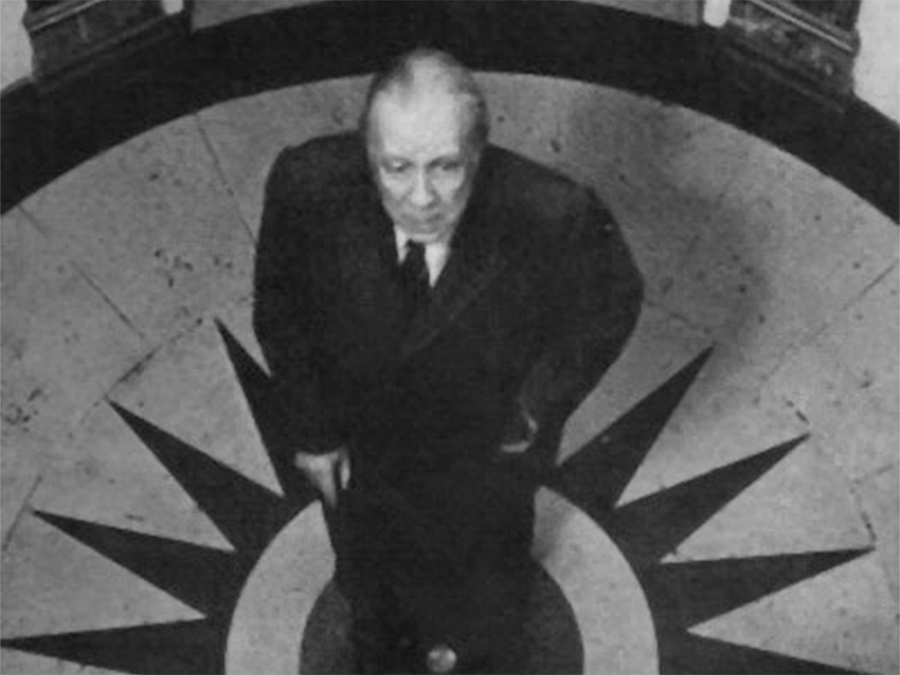

Jorge Luis Borges uses a debate between two medieval theologians to explore themes of infinity, orthodoxy, and personal identity.
Borges stories vary wildly in style and subject. After the gaucho/gangster story “The Dead Man“, which we covered in the previous installment of my Borges Marathon, this month we are in the territory of scholarly arguments between medieval theologians.
Judged by the usual criteria of short stories, “The Theologians” doesn’t work at all. The main character, Aurelian, has no real characteristics except his grudge against his rival, John of Pannonia, whose personality is sketched even more roughly—he only really exists as an object of Aurelian’s envy. The plot moves slowly through the explication of scholarly treatises, and there are few scenes of note, with no dialogue.
But we’ve already established in this series that Borges isn’t very interested in following the rules. “The Theologians” is a story of ideas, and it’s the ideas that propel it forward. Who are we, and what makes us unique? Borges uses invented medieval heresies as a way of exploring these questions. It’s in the same vein as “Three Versions of Judas“, a story I wrote about last year.
As Borges wrote in the afterword to The Aleph, the collection in which this story was published in 1949:
About “The Theologians,” suffice it to say that they are a dream—a somewhat melancholy dream—of personal identity.
The first concept of personal identity is represented by a sect called the Monotoni, who claimed that “history is a circle, and that all things that exist have existed before and will exist again.”
Symbols play a big part in this story, and in this case Aurelian is scared by the sight of the wheel supplanting the cross. He prepares a denunciation but is outdone by his rival, John of Pannonia:
The act of a single man, he said, weighs more than the nine concentric heavens, and to think, erroneously, that it can be lost and then return again is naught but spectacular foolishness. Time does not restore what we lose; eternity holds it for glory, and also for the fire. John’s treatise was limpid, universal; it seemed written not by a particular person, but by any man—or perhaps all men.
The Monotoni are vanquished and their adherents burned at the stake, claiming as they die that this is just one of many fires, that this has happened before and will do so again.
Years later, a new sect arrives: the Histrioni. Their symbols are the mirror and the obolus (a Greek coin). They claimed that every person has a double (another recurrent Borges theme), and that the real one is in heaven while we on earth are just the reflection. Whatever we do, they said, the other man does the opposite, and when we die, we join him and become one.
From this it follows that we should do horrible deeds so that our double in heaven will do good. Other members of the sect also believed that “the world would end when the number of its possibilities was exhausted; since there can be no repetitions, the righteous are duty-bound to eliminate (commit) the most abominable acts so that those acts will not sully the future and so that the coming of the kingdom of Jesus may be hastened.”
In condemning this heresy, Aurelian falls into a trap. He comes up with the perfect argument, but then realises that if he uses it, he will be condemning John of Pannonia as a heretic in the process. Despite their rivalry, he doesn’t want to do this, so he tries to obscure the source of his words. It doesn’t work—John is identified, condemned as a heretic, and burned at the stake.
Aurelian spends years wandering through distant realms, trying to justify his actions, until he is struck by lightning and killed. In heaven:
Aurelian discovered that in the eyes of the unfathomable deity, he and John of Pannonia (the orthodox and the heretic, the abominator and the abominated, the accuser and the victim) were a single person.
The Histrioni, it seems, were correct. But the ending also vindicates the Monotoni, who died at the stake claiming that the fires burning them were part of an infinite cycle of fires. Aurelian and John, who condemned them, end up being killed in the same way, as part of the infinite circle of history and time.
“The Theologians”, then, offers plenty to chew on in terms of the nature of identity, the transmigration of the soul, the circularity of history, and so on. I think it also calls into question a lot of the categories by which we define ourselves. It’s no coincidence that Aurelian turns out to be the same as his biggest rival, and they are both part of the same infinite cycle as the men they condemned to death. As we split into increasingly hostile groups based on party allegiance, race, religion and ideology, this story is a timely reminder that what we see in our enemies is not so different from what we see in the mirror.
There are 2 comments
As usual, reading your thoughts on each of these stories sparks my curiosity once more. (I know I’ve read all these, but it just doesn’t feel like that… I feel as though I barely remember some of the stories I read earlier this year!) Thinking about the set-up for this one, I was reminded of a lecture I heard a few weeks ago about ancient phiilosophers and how all that remains of one school of thought are the notes that various students took of his teachings when they attended… and how some of those students presented contrasting ideas of his philosophy in their notes. How easy it is to misunderstand one another (and ourselves, sometimes too)!
Fascinating story. I love how wide-ranging Borges is in his story subject matter and method. Even if he revisits the same themes, he seems never to do it in the same way.