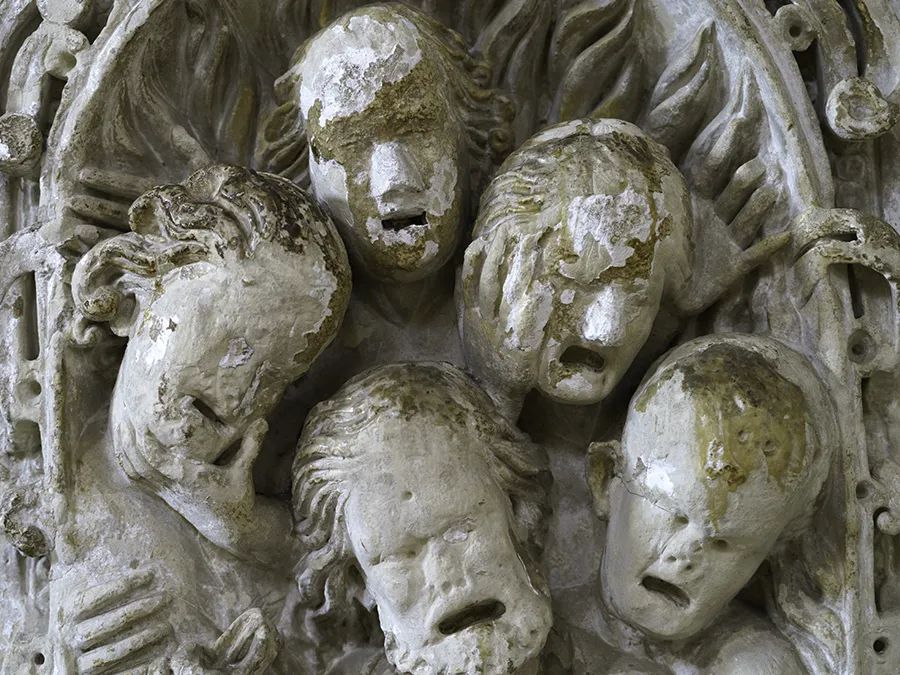

What would immortality feel like? Jorge Luis Borges takes us beyond the quest for eternal life to see what happens to someone who achieves it.
As today’s billionaires continue to pour money into immortality research, it’s worth taking a step back to ask what immortality would be like. Jorge Luis Borges provides some surprising answers in his short story “The Immortal”.
The story concerns a Roman military tribune who goes on a quest to discover the fabled City of the Immortals, bounded by a “secret river that purifies men of death.” It seems like a doomed quest, but by an unlikely series of circumstances he does find himself in the city and drinks from the river, achieving immortality.
Far from being the end of his quest, however, this is only the beginning. The City of the Immortals turns out to be a nightmarish place full of grand but incoherent and meaningless architecture:
“There were corridors that led nowhere, unreachably high windows, grandly dramatic doors that opened onto monklike cells or empty shafts, incredible upside-down staircases with upside-down treads and balustrades. Other staircases, clinging airily to the side of a monumental wall, petered out after two or three landings, in the high gloom of the cupolas, arriving nowhere.”
The architecture of the city prefigures the narrator’s disappointing discovery that immortality makes life meaningless. It is the prospect of death, the fleetingness of life, that gives it value. For the immortals, “every act (every thought) is the echo of others that preceded it in the past, with no visible beginning, and the faithful presage of others that will repeat it in the future.”
For that reason, the Immortals chose to destroy their original city, replace it with the crazy labyrinth the narrator discovered, and live nearby in complete abnegation of the world. They don’t even speak, causing the narrator to presume that they are uncivilised “Troglodytes”. He treats one of them like a pet, naming him Argos and trying to teach him basic words. One day, he hears him quoting from the Odyssey. He asks how much of it the man knows.
“Very little, he replied. Less than the meagerest rhapsode. It has been eleven hundred years since last I wrote it.“
The attainment of immortality, then, has turned Homer into an unspeaking cave-dweller. The only thing that eventually gives him and the other Immortals a sense of purpose is the realisation that since everything in the world is in balance, there must be a river somewhere that takes away immortality, just as this river bestows it. They go off in search of the river for thousands of years, until the narrator chances upon it in Eritrea in 1921 and feels himself becoming mortal again, able for the first time in thousands of years to feel pain and, eventually, to die.
The infinite is a major theme for Borges, and in “The Immortal” I found echoes of other stories from my Borges Marathon—especially “The Library of Babel” in which an infinite library turns out to be similarly nightmarish. We need limits, it seems—an infinite life, like an infinite library, makes individual existence meaningless.
If you’re a billionaire who’s invested heavily in immortality research, you’ll probably be disappointed. For the rest of us, though, I think it will probably come as less of a surprise to learn that immortality is not the ideal solution. As much as we fear death and want to keep it at bay for as long as we can, we also know that if you take away the possibility of death, of feeling pain, then you also take away much of what makes us feel alive.
And although human life can be quite wonderful on an individual level, it can also be quite hard collectively. It’s difficult enough to live through what we’re seeing today, but imagine if you’d also lived through Hitler, Stalin, Pol Pot, Ivan, Vlad, Caligula and a thousand others. Perhaps it would be as nightmarish as the City of the Immortals, or perhaps you’d simply stop caring, seeing everything as part of a long and meaningless procession of events. I don’t know which is worse.
We tend to think that taking the long view, seeing ourselves as part of something bigger, is a positive thing. To an extent, I think that’s true. But what “The Immortal” reminds us is that if you step back too far and become too distanced and equanimous, then everything dissolves. So by all means eat well, take care of yourself, and try to prolong your life by a few years. But immortality is probably best left to the gods.
There are 11 comments
Thanks for another entry from Borges. I am always chanting the same, but by Jove this year has to see me start Borges all short stories book I bought last year when I started reading your marathon reviews.
Your posts are so enjoyable to read that I am always sad to finish them and wait for new ones. It’s so inspiring, how Borges gave artistic shape to this concept of eternity. It’s so true that time and its limits is what gives meaning to our life experiences. Even for someone like me, a christian, eternity is not something achievable on Earth, it is something outside time and space constraints.
Hi Silvia, I’m glad you enjoy my posts and that they inspired you to read the book of Borges stories. Don’t worry, I know all about delayed reading goals 🙂 There are books I’ve been meaning to read since I started this blog, and that was in 2007! I’m sure you’ll get to it when it’s the right time for you to read it.
Yes, I always appreciate you post on Borges.
And as to immortality … 🙂
https://courseofmirrors.com/2026/02/08/thoughts-on-the-one-being/
Always good to hear from you, Ashen! Thanks for linking to your beautiful thoughts on immortality and eternity.
I’m pleased you went there 🙂
I suspect the billionaires would fail to see the moral of Borges’ story and think that they are so exceptional that it wouldn’t apply to them.
Oh yes, of course – no rules apply to them! I don’t think they’d ever read a Borges story in any case, but maybe they’d skim an AI summary to see if it contained any productivity or brain-enhancing tips.
At age 75, I can see that at age 20 I was immortal, there was time to do everything. Now, I’ve done some things and I wouldn’t mind being 20 a few more times to try other things. But maybe that’s reincarnation rather than immortality. I certainly won’t be looking for that river, I’d only get in the way of the kids.
Oh yes, I remember those days when time was infinite and so many futures were still possible. I’d love to be able to jump back into my 20-year-old self and experience that again. I don’t think I’d stick around too long, though.
Do you find yourself rereading any of the earlier stories you’ve read for your project, now that time has passed, when you come across one like this which recalls earlier stories, or leafing through (zipping through epubs) to see if there are other connections? I would imagine that would be even more satisfying with his stories than with some other writers’ stories, somehow.
Yes! Often I’ll see a reference or theme that reminds me of another story, but I don’t remember which one, so I go leafing through (yes, leafing – this is one of the few books that I have in hardback!) to find what I was half-remembering. And then I often come across another connections along the way.
Now that my marathon encompasses about a quarter of the stories, I can use my own posts as a reference/reminder too!