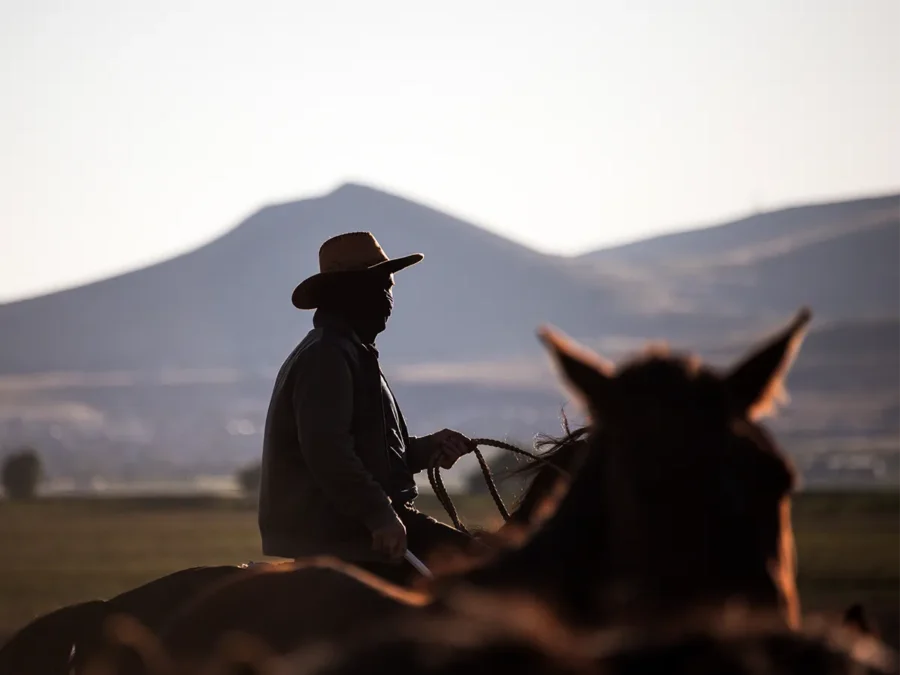

Borges takes us to the vast plains of the Brazilian frontier for an epic battle of wills between a grizzled gang leader and an ambitious pretender.
Recent installments of my Borges Marathon have explored the nature of immortality and created a story in the form of a riddle, but “The Dead Man” offers the more straightforward story of a power struggle amid a band of smugglers.
The setting is the “inexhaustible plains” of the Brazilian frontier. Benjamin Otalora, a “sad sort of hoodlum whose only recommendation was his infatuation with courage”, is forced to leave Buenos Aires after killing a man in a knife fight, and he finds his way to Uruguay where he joins a gang run by the scar-faced, black-moustached Azevedo Bandeira.
Otalora gets sent up north to begin “a life of vast sunrises and days that smell of horses.” He gradually proves himself, rises in the ranks, and begins to covet his boss’s wealth and power, as well as his beautiful redheaded girlfriend. He sees Bandeira when he’s ill and old, and he senses his weakness.
One thrust, he thinks, would be enough to settle that matter.
The redheaded woman enters the room and interrupts his thoughts of murder, but Otalora devises a more patient plan, based on using Bandeira’s own strategies against him.
Azevedo Bandeira is accomplished in the art of progressive humiliation, the satanic ability to humiliate his interlocutor little by little, step by step, with a combination of truths and evasions; Otalora decides to employ that same ambiguous method for the hard task he has set himself.
He gradually starts to push Bandeira out of the picture, working to build alliances within the group and take power for himself. He proves his mettle in battle, and soon he begins to alter Bandeira’s orders and take power for himself. He even sleeps with Bandeira’s girlfriend. The old man is now head of the group in name only, and it seems a matter of time before Otalora finishes him off with that single thrust he imagined earlier.
But, as happens so often in Borges, there’s a sudden twist in the very last paragraph of “The Dead Man”. The men who Otalora believes are on his side have in fact remained loyal to Bandeira. Just as Otalora thinks he is triumphing, he is abruptly executed.
Otalora realizes, before he dies, that he has been betrayed from the beginning, that he has been sentenced to death, that he has been allowed to love, to command, and win because he was already as good as dead, because so far as Bandeira was concerned, he was already a dead man.
When we look back over the story, we remember details like Bandeira’s “satanic ability to humiliate his interlocutor little by little, step by step, with a combination of truths and evasions”, and we see what he has done to the upstart who thought he was taking over. It’s a satisfying ending: it takes you by surprise, but then it makes perfect sense when you think about it.
Throughout “The Dead Man”, Borges evokes a strong sense of the dangers of pride and hubris. Otalora is brought low just when he thinks he has reached the very height of his ambition. It reminds me of other Borges stories where the hero is abruptly brought down to earth, such as “Hakim, the Masked Dyer of Merv” and “Death and the Compass“. It’s a useful reminder of the futility of striving after things that can be so easily snatched away. Borges often uses gangsters and knife fighters as his protagonists, but life is fragile for all of us and can be taken away in a heartbeat, even if we don’t try to double-cross a violent gang leader. Perhaps that’s why hubris is such a recurrent theme in Borges stories.


There are 3 comments
Another good story. I like how Borges’ titles often mislead. I mean, in this case, the reader will think the dead man of the title is Bandeira, but really from the start the dead man is Otalora. Bait and switch!
Yes, exactly! You’re right, there are plenty of Borges stories where the titles are intentionally misleading. I could probably write a post about that one day as an addendum to my Borges Marathon – if I ever get that far!
Of course you will get that far: you once thought you wouldn’t’ve gotten THIS far!