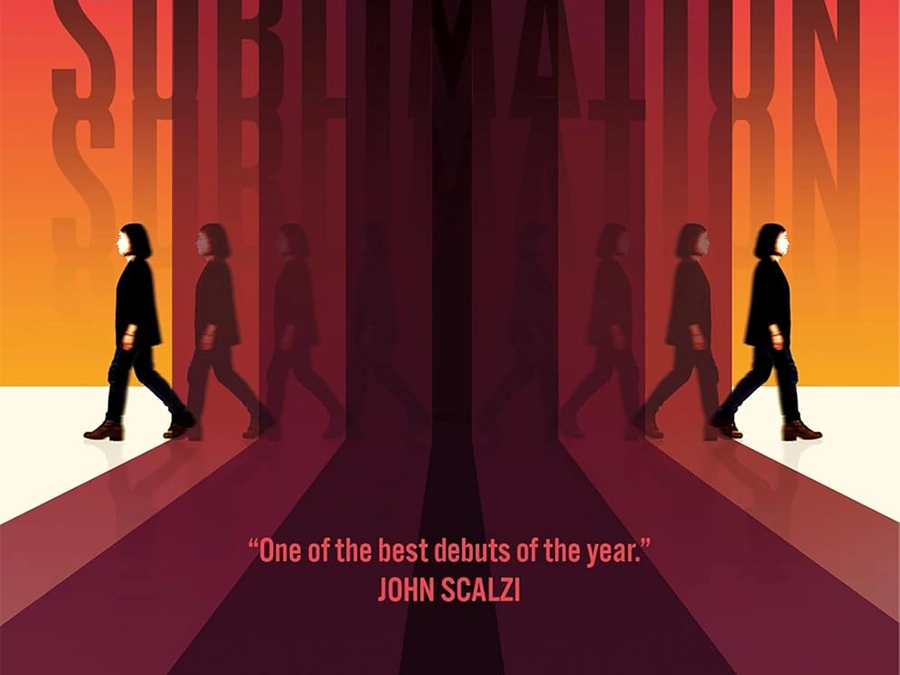

What would life be like if you left a version of yourself behind when you migrated? This thoughtful sci-fi novel introduces “instancing” as a powerful metaphor for the rupture of migration.
I don’t normally read much science fiction, but I was attracted to Sublimation by Isabel J. Kim because of its use of doppelgangers and its central theme of migration. I’m glad I took a chance on it.
The world of Sublimation is mostly like our world, but with one key difference: the phenomenon of “instancing”. When people leave one country to go to another, they often leave behind another version of themselves. They are doubled, in other words, with one person living in the new country and an identical person staying behind at home.
“An instancing captures a static moment. A feeling in a specific time and place. The heart at the moment of stepping over a border. The mind when it knows it is leaving.”
Of course, they may be identical at the moment of the instancing, but the two versions of the same person then have very different experiences and become different people over time, which is where a lot of the plot development comes from.
What I found fascinating about instancing is how it’s a sci-fi device that sheds very interesting light on the reality of migration. When people leave their home and move to another country, they often talk about leaving a piece of themselves behind. You could easily read Sublimation as a kind of extended metaphor to capture that feeling of duality, the fracturing that can result from being ripped out of one reality and starting a new life in a foreign land.
Soyoung left Korea with her mother at the age of ten and moved to America, where she became Rose. The American instance, Rose, has never met or even spoken with her Korean instance, Soyoung—the one who stayed behind. The death of her/their grandfather prompts her to go back to Korea for the first time, where she encounters not just her own instance but also the Korean instance of her mother.
I won’t spoil the entire plot for you, but I will introduce one more concept: reintegration. It’s possible for the splitting to be reversed, for the two people to become one again when they meet in person and share physical contact. It’s possible for that to happen even if one of them wants it and the other doesn’t.
The result is a new person with the experiences and memories and desires of each individual, but no separate individual consciousness any more—they’re a single person, with all those conflicts tainting every memory, every relationship. They’re a different person, and friends and loved ones of the individual instances are now part-intimate, part-stranger.
“Every bit of the past feels fake from the dissonance, the sheer divorce of her past selves from her present decisions coloring even the combined memories. Her prior emotions are dead things in her chest. Like the stickers she saved as a kid, pretty little scraps of paper that meant something a long time ago, but have no meaning now.”
Plenty more happens after that, and after a fairly slow, thoughtful start, the novel picks up to a thriller-like pace towards the end. It’s all quite enjoyable and is resolved in a satisfying ending, but what I liked most about Sublimation was its exploration of the concept of identity.
We tend to think of ourselves as solid, stable entities, but of course we change all the time based on the decisions we make. If I’d never left England, I would be a very different person from the one who left at 22 and has been bouncing around the world ever since. If I met that Andrew who’d stayed behind, how much of him would be recognisable? And if we reintegrated and I suddenly had to deal with his/our wife, his/our children, his/our life, how would I cope?
On the other hand, how much of that other Andrew would be the same as this one? That sameness that exists beyond the divergent memories and relationships is probably my core identity. But it’s interesting to think about how much of who we are is changeable and shifting, dependent not just on big events like migration but on every decision we make from day to day, the large and small ways in which we step into new realities and leave others behind.
Thanks to NetGalley for an advance review copy of Sublimation, which will be published by Tor Books in June 2026.

There are 8 comments
It seems a great book. The concept of identity is very interesting and this book sounds well written. I too wonder how I would be had I stayed in Spain instead of migrated to the States. I also imagine how I would have loved to be like you, living in different places around the world.
It certainly got me thinking too, Silvia! That’s what good novels often do – prompt us to see life in a different way and think about other possibilities. I am very happy with all the different experiences I’ve had and all the places I’ve lived and visited, but I also wonder what it would have been like to live a more settled, rooted life.
I have made a note of this book for when it is released. In SF (that I have read) this process of mind transfer is sometimes used for interstellar travel, and I’ve seen the idea of multiple copies of one mind being explored, most recently in the Bobiverse series by Dennis E Taylor. Interesting to confine the process to Earth in order to explore the implications without the distractions of multiple worlds.
Reminds me I should reread Robert Sheckley’s Mindswap.
Thanks for mentioning these, Bill – as I mentioned, I don’t read much sci-fi, so I don’t have a lot of context to contribute. I’ll have a look.
Oh, this sounds like a good one. I will keep my eye out for it!
I think you’d like it, Stefanie. I framed it as sci-fi, but I think it’s more on the literary end of the spectrum, like Ishiguro’s more speculative work. Changing an important detail is an interesting way to reflect on the world we live in.
This looks so intriguing and one I will put on my list. I’ve been reading much lighter stuff lately! Your recommendations always challenge me. The last one I read at your level is Hisham Mater’s “My Friends.” I couldn’t even comment on your last post because I was too down about the state of my country and its impact on the world, and I know the “world order” has never been what it should be, but we’ve sunk so low.
I can certainly understand that, Bean! Thanks for mentioning My Friends – I hadn’t heard of the book or the author before, but it looks excellent.