
Stop lamenting the demise of a system that never existed, and start imagining what it would be like if rich nations really did play by the rules.
Amid the mayhem and war crimes of the Trump administration, there has been much liberal angst about the decline of the rules-based international order. Canadian Prime Minister Mark Carney’s speech at Davos is a famous example, but you can find echoes of it in op-eds, social media posts and TV coverage across the Western world.
For decades, the story goes, the world was a stable system based on cooperation and rising prosperity, until Donald Trump came along out of nowhere and took a wrecking ball to the whole thing. Now, we are entering a new, dangerous era of constant competition and conflict. As Carney put it, with a nod to Thucydides:
“It seems that every day we’re reminded that we live in an era of great power rivalry, that the rules based order is fading, that the strong can do what they can, and the weak must suffer what they must.”
There’s just one problem with that story: the rules-based international order never existed.
Carney and others often pause briefly to acknowledge that the story of the rules-based international order was “partially false,” before going on to continue their argument about its merits and how disastrous its demise is. That is akin to sweeping some very large items of furniture under a very small rug. The hypocrisy and lies cannot be relegated to a footnote when they were so central to how the system operated.
First of all, let’s talk about the phrase itself. The rules-based international order is usually presented to us as a benign gift from Western leaders who, appalled by the violence and barbarity of World War II, set about to construct a system that would prevent such a catastrophe from happening again.
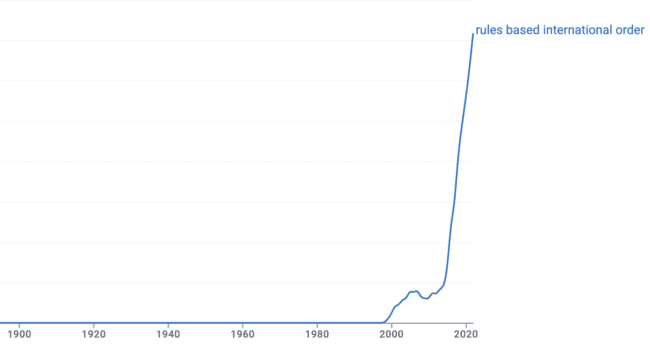
But nobody in that period ever talked about a rules-based international order. This graph from Google Ngram shows how often the phrase is mentioned in books published in each year. It’s a flat line for most of the 20th century, before surfacing in the late 1990s and spiking in the late 2010s.
That’s because the foreign-policy priorities of Western leaders had little to do with rules and order, and a lot to do with preserving their colonies in the case of Europe and defeating the scourge of communism in the case of the USA. They didn’t want to be constrained by rules in either case, and they weren’t. The USA conducted regime change, installed and supported violent dictators, fought violent wars, assassinated opponents, etc. Britain tortured and castrated Mao Mao rebels in Kenya. France fought bitterly to hold onto Algeria, with a cost of more than a million Algerian lives.
These are just a handful of examples among many, many others. The great powers were never constrained by rules. The zenith of the rules-based international order looks a lot like a world in which the strong can do what they can, and the weak must suffer what they must.
So why the spike in usage of the term in recent decades? It’s simple: after the end of the Cold War and the demise of the Soviet menace, the West needed a new organizing principle to justify American hegemony. There was some talk in the 1990s of the end of history, peace and prosperity and that kind of thing, but that wouldn’t support massive spending on the military-industrial complex.
So the rules-based international order was born, with America as “the world’s policeman”, fairly but firmly enforcing those rules. As we’ve seen, though, that was never the case. Based on the historical evidence, America looks a lot less like the world’s policeman and a lot more like the world’s mob boss.
And there, perhaps, is a hint at the true meaning of all this worry over the decline of a fictional order. Mob bosses, after all, unleash violence on outsiders while being fiercely protective of their clan. As long as you’re part of the famiglia, you can enjoy the riches and just look the other way when someone else ends up at the bottom of a river in concrete shoes.
A few things have changed under Donald Trump, and one of them is that American aggression is no longer directed solely at the Global South. Now, Canada is threatened with Anschluss, Denmark is threatened with the seizing of Greenland, and Europe is very bluntly told that the U.S. is no longer its protector. Then there are the trade wars, the tariffs, the barrage of ideological warfare. Imagine a mob boss telling his most trusted lieutenants that he’s going it alone and doesn’t need them any more. That’s more or less where trans-Atlantic relations are right now.
Another thing that’s changed under Donald Trump is the abandonment of pretences. A war of aggression is a crime under international law: it’s what many Nazis were prosecuted for at the Nuremberg trials. Previous leaders of the U.S. and other war-mongering nations have gone to great lengths to justify their wars of aggression by painting them as acts of self-defence or ensuring that they were sanctioned by the UN Security Council. So we had to live through absurdities like invading Afghanistan in support of women’s liberation and searching every inch of Iraq for weapons of mass destruction that nobody really expected to find.
Trump doesn’t care about any of that. He just unleashes air strikes, abducts or kills foreign leaders, lets the civilian casualties mount, and he doesn’t even try to make it anything other than what it is: a war of aggression, aka a war crime. He doesn’t even bother to consult Congress, let alone the UN.
That puts his allies in a very difficult position. Even the most invertebrate politicians like Sir Keir Starmer have been forced to issue mild rebukes and carefully worded prevarications. Tony Blair stood proudly behind George W. Bush throughout all of his war crimes, and he could do so because he had plausible deniability. Who could possibly have known that the WMD were fake? He and other Western leaders could support mass violence while plausibly claiming to uphold the rules-based international order. Now, that line is impossible to walk.
I’ve been focusing on war and violence, perhaps because the destruction in Iran is so fresh in my mind right now, but the other much-praised elements of the rules-based international order were a fraud too.
In his speech, Carney talked about things like “a stable financial system” and “frameworks for resolving disputes.” He means institutions like the World Trade Organization and the International Monetary Fund, which, in the liberal Western imagination, set fair rules and boundaries to support free trade around the world and enhance prosperity.
Here’s what Harvard International Review has to say about the IMF’s record in that regard:
“After West African countries were forced to follow the IMF’s structural adjustment programs in the 1980s and 1990s, spending on education decreased by 25 percent and spending on healthcare decreased by 50 percent. This reduction in important social services spending caused an estimated 500,000 deaths of children in Africa.”
Meanwhile, the WTO was used by rich nations to open markets in poor nations. The rules only applied one way: poor countries had to remove subsidies for their domestic industries in the name of free trade, while the EU continued to subsidize its agriculture, the USA continued to subsidize its cotton, etc. For some reason, this article about Burkina Faso cotton farmers going out of business due to US cotton subsidies stuck with me so much that I found it again 20 years later. Then there’s the case of Chiquita lobbying Washington to use trade rules to cripple the Caribbean banana industry, devastating the economies of small islands, and a thousand more examples. (And, as an aside, people often forget that the WTO, despite often being presented as a foundation of post-war prosperity, was only created in 1995.)
Despite my bashing of the rules-based international order, I desperately want it to exist. A true rules-based international order is our only hope of securing a future with any measure of peace, justice and shared prosperity. Here are what I see as the minimum requirements of such an order:
- Abolition of the UN Security Council. Why should a handful of former colonial powers have veto power over the rest of the planet?
- A democratic, transparent United Nations that represents the interests of all people in all countries and has genuine power to resolve disputes.
- A global agreement to place very low caps on military spending and drastically reduce current arsenals—comparable to the nuclear disarmament of the 1980s but for all kinds of weapons.
- Divert former military spending to investment in ending poverty and improving people’s lives. It would take just 4% of current global military spending to end global hunger by 2030, according to the UN. Imagine what we could do with the other 96%.
- Immediate agreements to end fossil fuel dependency and avoid the worst effects of climate change. If a rules-based international order can’t create and enforce rules to make the planet liveable for the next generation, then what good is it?
- Acknowledgement of historic injustices and a genuine effort to make amends through concerted policies to reduce inequality, both within and between nations.
- Prosecute all war crimes equally—no exemptions for powerful nations or leaders. If anyone does what Trump and Netanyahu just did, they should be arrested and tried in court, like any other law-breaker.
What we had from Truman to Biden was nowhere close to that. What we have under Trump is undoubtedly worse, undoubtedly more dangerous, but please stop lamenting the demise of a system that never existed. Instead, let’s focus our energies on building a genuinely rules-based, genuinely international order while there’s still time.
Sure, I know it’s impractical. Even seeing just one of those bullet points come true in my lifetime would be a miracle. But without it, we only have increasing barbarism on a burning planet to look forward to, so I think it’s probably worth a shot.

There are 9 comments
I appreciate that you’re writing about this. It feels very weird to post about books and reading all the time, when so much is happening. I’m sure I’m spending more time listening to and reading news on any given day than I’m spending reading, but nobody would know that from BIP. Simply prioritising the space and time to highlight these ideas is important. And it invites a different way of thinking and an exchange of ideas.
We’re largely in agreement I think (maybe entirely, even), but the question of what conversations it is possible to have is also relevant. That speeches like Carney’s and Sanchez’s (yesterday) have seemed so remarkable, it says as much about the public silence opted for by many world leaders, as it does about their speeches’ contents. That it is a courageous act to express even a hint of independence now? let alone resistance? So, then, to have the kind of conversation you’re positing? It does seem, as you’ve said, impractical.
Taking it to the individual level, I’m unable to convince many people I know to even LOOK at what’s happening, let alone discuss it, let alone support political leadership that would prioritise alternatives that are more just and equitable. Every one of them is actually part of this conversation too, but silent and motionless… possibilities limited at kitchen-tables and in global-forums alike.
Hi Marcie, I know what you mean. I’ve been planning to write something about everything that’s happening in the non-book world for a long time now, but it always feels like too much, and I’ve been struggling with lack of time and energy, and I don’t know where to start. But after the Iran news broke, I decided just to start and see where it took me.
You’re right about the possibility of conversations. I hadn’t seen that Sanchez speech, so thanks for mentioning that. It doesn’t surprise me – he’s one of the only European leaders who had the courage to name the basic reality of the Israeli genocide in Gaza. I don’t know why the others feel so wedded to the historic model of blind allegiance to U.S. aggression. It served Europe very well during the Cold War, but that model is clearly over now, so they need to pivot and find new alliances, as Carney said.
It’s a big world out there, and even if Trump hits you with 2,000% tariffs because you dared to criticise him, you’ve still got the other three-quarters of the global economy to trade with. Europe needs visionary leaders to chart a new course, but instead it’s saddled with people like Starmer and Merz, who are so cautious that they couldn’t decide what to have for dinner without asking a focus group first.
It is such a LOT right now but, ironically, (paradoxically?) hiding from a source of discomfort never brings peace/security because each of us is gifted at imagining hellish things: I’ve found it’s much better to confront what’s really happening and then quickly find a way to take action (however that is expressed).
When it comes to the tariffs, I think one factor that is likely difficult to discern is sacle; some countries (and maybe this is heightened in Canada cuz… geography) have been so inordinately intertwined with the U.S. that it requires large-scale change to engage with the rest of the trading world. More than one would guess.
What I learned about the auto industry on both sides of the border, between Detroit (US) and Windsor (C) for instance: how one factory would be responsible for making one side of a fastener another factory on the other side responsible for making the other side of a fastener. Massive facilities built to specialise in ways that demand cooperation and fully breakdown when that relationship fails. (I can’t recall exactly which tiny parts specifically, but it blew my mind, this talk of specific components and which were made where.)
So, maybe for those who KNOW, it’s just too hard to talk to those who DON’T? And maybe for those who don’t know, they just REALLY don’t want to know?
You’re right about those trade entanglements. This is what Britain discovered after leaving the EU – it’s very complicated and time-consuming to unravel those supply chains that have taken decades to build, and there’s a big cost. I remember crossing back and forth over that US-Canada border in happier times – I took a trip to Toronto or Ottawa every time I changed from one US visa to the next (work to student and back to work again) and needed to re-enter the USA. The volumes of people crossing were huge, and there didn’t seem to be many checks. So it would be very hard for Canada to detach itself from the US.
What I struggle to understand is how EU leaders can be less bold than Carney, more mealy-mouthed and desperate to hold onto US apron strings just a little longer. I think the US accounts for around 20% of EU trade – so a very significant chunk of change, but not as existential as it is for Canada, where I believe it’s more like two thirds. And a lot of it is finished goods, not the kinds of small, interconnected components you’re talking about with Canada. So I think it would be easier for Europe and the UK to pivot away from the US in terms of trade.
What European leaders are more scared of, I think, is losing US military protection – understandable, but it’s becoming increasingly doubtful that the US would stick its neck out to protect them anyway. And maybe if they hadn’t helped the US undermine the United Nations over so many decades, they’d have that to rely on now.
In general, I agree about our ability to imagine hellish things, but recently I’ve found reality outstripping even my morbid imagination. Consider this recent nightmare-inducing gem, for example:
“As the U.S.-Israeli war on Iran rages on, U.S. military commanders have reportedly been invoking extremist Christian rhetoric about biblical end times, selling the conflict to American troops as a holy war. The watchdog Military Religious Freedom Foundation says it’s been inundated with more than 200 complaints from members across all branches of the U.S. military regarding these comments. One combat unit commander reportedly said the war is “part of God’s divine plan” and that, quote, “President Trump has been anointed by Jesus to light the signal fire in Iran to cause Armageddon and mark his return to Earth,” unquote.” (https://www.democracynow.org/2026/3/9/military_religious_freedom)
Immersing myself where I can on a very small local level, and beyond that, I’m sticking to books because the insanity is too much. So much more courage and independence in book characters than national leaders:(
I understand that, Bean. I think you can have a real impact on a local level, especially in the work you do as a teacher. If you can help some of those kids navigate what’s coming and encourage them to read and think critically, that is a big contribution.
This is such a good post Andrew! You are right, there never has been a rules based order, it is all neo-liberal propaganda that enforces rules for “you” but not for “me” with the haves enriching themselves on the lives and work and resources of the have-nots. The world would be a so much better place if even a few of your suggestions were implemented, but sadly I can’t see that happening, at least not in my lifetime.
And yes, there are a lot of Christian Nationalists in the current administration salivating over the war with Iran potentially bringing on the End Times. They are so sure they are saved, but they are going to be in for a big surprise.
I second what Marcie said about tariffs and trade. Trade in North America is so enmeshed between the U.S., Canada, and Mexico that all sorts of parts and pieces of things regularly cross the borders that go into the making of one single product. I heard not long ago that the average for a basic new car in the US is now $50,000!
Thanks Stefanie! Yes, those people longing for Armageddon are truly terrifying. Did you read Naomi Klein’s essay about end times fascism last year? I think you did and probably wrote about it on your blog, but here’s the link in case you (or someone else reading these comments) wants to check it out: https://www.theguardian.com/us-news/ng-interactive/2025/apr/13/end-times-fascism-far-right-trump-musk
Thanks! I did read it, but it’s always good to be reminded because it is unfortunately still relevant.