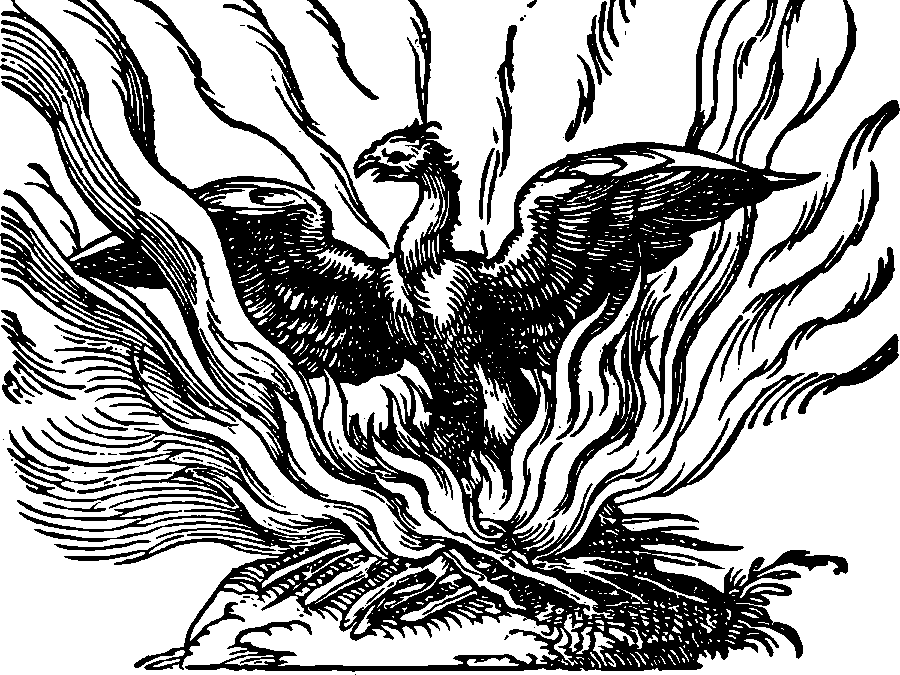

What is the mysterious ritual at the centre of this Jorge Luis Borges story? Let’s go through the hints and solve the riddle.
The fictions of Jorge Luis Borges take many forms, from detective stories to complex thought experiments and from fictional academic articles to biographies of historical figures who never existed. In “The Cult of the Phoenix”, Borges tries out a different form: the riddle.
The story describes a mysterious cult whose central ritual is called “the Secret”. Despite being shrouded in mystery, the cult has members all over the world, and the practice of its ritual is pervasive. Borges drops plenty of hints but never specifies what the Secret is—the point of the story is to guess it. This is, in other words, a story-length riddle.
Here’s what Borges wrote in the prologue to Artifices, the collection in which “The Cult of the Phoenix” first appeared in 1944:
In the allegory of the Phoenix, I set myself the problem of suggesting a common act—the Secret—hesitatingly, gradually, and yet, in the end, unequivocally; I am not sure to what extent I have succeeded.
I think he got the balance just right in terms of setting the riddle: it’s by no means obvious, but all the clues are there for a reader to be able to put it together.
By the way, I’ll be compiling hints and then finally revealing the answer to the riddle at the end, so don’t read to the end if this will spoil the story for you.
The first clue is in the title: the phoenix is of course a symbol of rebirth. Then we read that “there is no group of human beings that does not include adherents of the sect of the Phoenix”, so clearly this is a very common act. The Secret is “transmitted from generation to generation, but tradition forbids a mother from teaching it to her children.” The ritual is “sacred” but also “a bit ridiculous”. Then we have this:
The performance of it is furtive, even clandestine, and its adepts do not speak of it. There are no decent words by which to call it…
Finally, we learn that many worshippers say the Secret “at first struck them as
banal, shameful, vulgar, and (stranger still) unbelievable. They could not bring themselves to admit that their parents had ever stooped to such acts.”
When I put all the hints together like that, perhaps it’s obvious that the Cult of the Phoenix is all about sex. But in the story itself, they’re spread out among a mass of arcane description so that the hints do appear “hesitatingly, gradually” as Borges intended.
So it’s a successful riddle, but is it a successful story? I think the trouble with a riddle is that its only real interest lies in finding the solution. There’s a certain amount of fun to be had in following the clues, but it feels shallower than much of the other material in Borges’ Collected Fictions. At his best, Borges conjures up a myriad of creative possibilities in a single piece of fiction, so to have a story devoted to finding a single answer feels a bit of a letdown.


There are 6 comments
Maybe a let down, but you’ve got to hand it to Borges for being so incredibly versatile and willing to try to many different kinds of stories.
Yes, I love the variety – when I first read this collection, it expanded my ideas about what fiction could be.
And I still want this to be the year I read his short stories. Merry Christmas, and looking forward to more posts from you and hopefully an even more satisfying read!
OK, you were cutting it fine! I hope you managed to read them in the end. Picturing you in a nice warm living room with a roaring fire and a big volume of Borges stories over the holidays.
I think it just depends on one’s mood, and I bet having the other longer, more intricate, more deeply satisfying stories in your JLB collection raise your expectations a little? I’m thinking about a single-sentence story that I read recently, which left me a tiny bit disappointed, but when I quoted it in a post, another reader found it very striking. /shrug But, then, if it all comes down to mood, why do we ever read in the first place? heheh
I agree that mood affects the reading experience, but I’m not sure I would have liked this one much in any mood. You’re right, though, that different readers can have wildly different experiences, and there’s probably a “Cult of the Phoenix” fan out there waiting to deliver an angry comment. Maybe even a cult fan…