

My review of Cat’s Eye by Margaret Atwood, the story of a middle-aged artist who recalls traumatic bullying in her childhood.
For this year’s Margaret Atwood Reading Month, I read Cat’s Eye, a novel about a successful painter who returns to her home city of Toronto for a retrospective exhibition and ends up revisiting the trauma of being bullied as a nine-year-old child by her ‘friend’ Cordelia.
The bullying is central to the story, but Cat’s Eye is also about much more than that. The novel takes us forward through Elaine Risley’s life to see what happened after, how the experience shaped her and continues to affect her decades later. Although the story of the bullying itself is powerful, things got more interesting for me when they all got older and the roles of victim and perpetrator became more blurred.
“I’m not afraid of seeing Cordelia. I’m afraid of being Cordelia. Because in some ways we changed places, and I’ve forgotten when.”
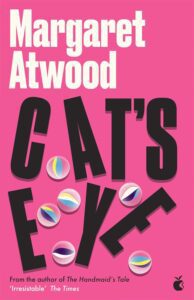
The name Cat’s Eye comes from the special cat’s eye marble that Elaine cherishes as a child. She keeps it in a red plastic purse, and it’s one of the few things she can hold onto amid the misery of being treated so horribly by Cordelia and her two other friends. It’s a symbol of hope, and there’s a moment when Cordelia seems about to take the marble from her and it seems essential for Elaine to hold onto it, which she does through a casual lie. When the adult Elaine rediscovers the red plastic purse years later, it triggers memories that she’s long suppressed.
Atwood does a great job of taking us into Elaine’s world, painting a picture of postwar Toronto suburbia that seems very confined and claustrophobic. Elaine’s parents seemed ordinary enough to me, but they are different enough to stand out amid the sameness around them, and Elaine stands out too for being more comfortable accompanying her entomologist father on bug-hunting expeditions or playing boyish games with older brother Stephen than conforming to the behaviour expected of girls at the time.
What I found most heartbreaking about the bullying was not the cruelty of Cordelia or even the cowardice of the other friends who go along with it, but the way Elaine accepts it and keeps desperately trying to please them. Her ‘friends’ keep telling her that everything she does is wrong and they’re just trying to help her improve, and she believes them and tries to be better, even though nothing is ever good enough.
“Cordelia is my friend. She likes me, she wants to help me, they all do. They are my friends, my girlfriends, my best friends. I have never had any before and I’m terrified of losing them. I want to please. Hatred would have been easier. With hatred, I would have known what to do. Hatred is clear, metallic, one-handed, unwavering; unlike love.”
It’s a relief when, after a particularly nasty episode that almost kills her, Elaine finally realises that these people are not her friends and she doesn’t need to listen to them. As soon as this happens, the bullies lose their power over her. Their bullying was mostly not physical but emotional and psychological, so when Elaine stops believing in their power, it ceases to exist. Elaine finds a new friend, and her tormentors quickly fade into the background of her life, before they all move on to different schools.
However, the story is far from over at this point. Elaine may have escaped from Cordelia’s grasp, but she has not recovered completely. There’s a brittleness to her, perfectly captured in the image she gives of herself at that time as “happy as a clam: hard-shelled, firmly closed.” When her mother refers to “that bad time you had”, Elaine has no idea what she’s talking about. She has survived and moved on by blocking all memory of the trauma.
Although she’s blocked the details out, the cruelty still shapes how Elaine sees the world. When she and Cordelia reconnect as teenagers, the dynamic has changed completely. Now it’s Elaine who is in control. She doesn’t take revenge exactly (she is so deep in denial that she doesn’t even know what to take revenge for), but she does behave with a cruelty that she never knew before.
“I can’t account for my own savagery.”
The novel is structured in 15 sections, each of which begins with a chapter from Elaine’s life as an adult before going back to the past. In the adult sections, we see how that childhood trauma continues to affect her. Even when she stops to help a drunk on the streets of Toronto as everyone else walks past, she sees Cordelia’s green eyes in her and draws her hand back sharply. Despite trying to do good, she fails:
“I know too much to be good. I know myself. I know myself to be vengeful, greedy, secretive and sly.”
As the past sections move forward into young adulthood and gradually catch up to the present day, we see how Elaine has been professionally successful but still is that hard-shelled clam, protecting herself from being hurt again by keeping herself firmly closed. It’s only when she returns to Toronto and begins to examine the painful childhood memories let loose by that cat’s eye marble that she has a chance of prising the shell open.
I read Cat’s Eye as an e-book, and I was surprised to discover afterwards that in print it’s about 500 pages long. It didn’t feel like a particularly long novel to me, which is probably a good sign. There’s plenty of depth here, plenty to explore in Elaine’s life, and that’s probably why it made the Booker shortlist back in 1989 (losing to Ishiguro’s The Remains of the Day). I haven’t read much Atwood, and this made me want to read more.
You can find some different perspectives on this book by reading the reviews by Bill and Marcie from a previous edition of Margaret Atwood Reading Month. Have you read Cat’s Eye? Do you have a favourite Atwood novel or a recommendation for what I should read next? Let me know in the comments.


There are 16 comments
Thanks for the link Andrew. After 4 or 5 MARMS I think Cat’s Eye might be my favourite Atwood.. I’ve read a few of her early ones now and she returns over and over to the ravine and being bullied. You get the impression she’s working something out.
Ah, that’s interesting to hear, Bill. This novel felt quite autobiographical to me, but I don’t know anything about Atwood’s life and haven’t read much of her other work, so wasn’t sure how much of it was based on reality. The repetition in other works does suggest that there’s some truth to it, perhaps a formative experience that she was grappling with herself. I guess we’ll probably never know the details, but it’s interesting what you can glean from reading multiple works by an author and seeing what they return to. This is my first MARM participation, but maybe I’ll try some of the others in future years.
The ravines also appear in The Blind Assassin, on the first page with a key event, and then there is a later scene with two lovers beneath a bridge. (I went to take photos of that area but haven’t been able to find the files!) There is a short story in Bluebeard’s Egg in which a home backs onto the ravines too. (And they do show up in other writers’ novels too.) But I recall you saying, Bill, that you’d come across them more than once in MA’s novels, and now can’t think where else. The idea of feeling targeted, taken down verbally at least, does proliferate.
It’s interesting to hear about the recurrences. Bill also mentioned in his recent post that a ravine shows up in Lady Oracle, with some strikingly similar events (and a few differences). And the bullying too.
Wonderful that you went to take photos in the area – would love to see them if you ever rediscover the files. They’ll probably turn up one day when you’re looking for something else 🙂
Excellent review, Andrew. I have read Cat’s Eye and I did enjoy it, but there are other Atwoods I prefer. Alias Grace is my favourite, where I think she manages to say something quite profound in a brilliantly paced and plotted novel. Still, I enjoyed revisiting Cat’s Eye through your eyes and in particular hearing your take on Elaine.
Thanks, Victoria! I’ve heard good things about Alias Grace, and you make it sound wonderful, so I think I’ll try that one next.
Great review, Andrew. It’s years and years since I read this and I do want to revisit it. Like litlove, I think very highly of Alias Grace and have happy memories of The Blind Assassin. There’s a lot of Atwood to explore!
Yes, there is so much to explore! Thanks for your recommendations – I may well read Alias Grace next, and The Blind Assassin is another that I’ve heard good things about.
Great review!
I have enjoyed some scifi by her, but not sure if this topic is really grabbing me
Oh yes, I’d like to try her sci-fi one day. Which one would you recommend?
I loved reading this, especially your views of Elaine and how time passes in the novel and what things change and what things don’t. Her shell. And then rereading via the links you shared; I didn’t even remember my own post, so it was like reading it for the first time. heh It’s interesting that I felt so emotionally devastated by her description of experiences being bullied, but it felt like a superficial literary mechanic in Bill’s reading. But I guess it’s inevitable that much of our reading experience is shaped by our real-life experiences.
In response to your quote about ‘goodness’, here’s one from The Blind Assassin that fits nicely, about the two sisters in a photo: “Both of us are smiling, in that apprehensive way children have when told they must be good and smile, as if the two things are the same: it’s a smile imposed by the threat of disapproval.” Even there, we have a hint that what’s captured in a photo isn’t really connected to the real people pictured. Also, there is a glass eye that appears twice in TBA and now I realising the connection that I was searching for and couldn’t quite place! Hmmm.
Thanks for joining in with MARM this year; I’m glad you found a place on the comfy couch and found so much to think about in Cat’s Eye!
Hey Marcie, thanks so much for organising MARM! I’ve wanted to participate for years now but always seemed to run into deadlines and busy periods that prevented me. I’m glad I found time for it this year. Have enjoyed reading the other reviews, and I enjoyed reading and writing about Cat’s Eye.
Thanks for adding this extra context, which is really helpful (and it’s also great to know that I’m not the only one who completely forgets about posts from a few years ago!). You’re right about the reading experience being shaped by our own experiences. It’s fascinating to read different people’s reactions to the same novel. And I love that quote about being good and smiling! Atwood is very good at capturing those kinds of nuances, making us look afresh at everyday things and think, “Yes, that’s it!”
This was great! I read Cat’s Eye a long time ago but your review brought it all back and has made me want to reread it. Maybe I will start a MA reread project next year. Hmmm. Anyway, favorite Atwood for me is actually 3 books, her MaddAddam trilogy.
Ah, that’s great to hear, Stefanie – I was wondering about trying her speculative fiction too, so I’m glad you liked that trilogy. Nice idea about the reread project too. I often get a lot out of rereading books and intend to do it more often, but there are always so many new books catching my eye too!
I read this book when it was first published, years and years ago, and felt that Atwood was writing about me. I, too, had similar experiences, bullying, and it was most difficult for a tender girl who tries to do things right. Who can’t believe that someone could deliberately lie and manipulate. I’ve thought of revisiting this book, but then I wonder if I have the courage. Cat’s Eye, The Robber Bride, and Surfacing remain my favorite Atwood books. I have thrown out all others since then, Oryx and Crake comes to mind, as do The Handmaid’s Tale and The Blind Assassin. I absolutely can’t stand her futuristic, feminist works, and miss the early ones which resonated within me far more deeply. It is interesting, though, to see how she has evolved in her writing.
Oh, I’m very sorry to hear that. I really felt for Elaine in this book (and, by extension, Margaret Atwood since she seems to have gone through something similar). It’s hard to understand such cruelty even as an adult, so for a child experiencing that from people she thinks of as friends must be overwhelming. I can understand why you’d have second thoughts about revisiting this book. Thanks for the recommendations of The Robber Bride and Surfacing – haven’t heard much about those ones, so I’ll do some investigating and maybe try them for next year’s event.